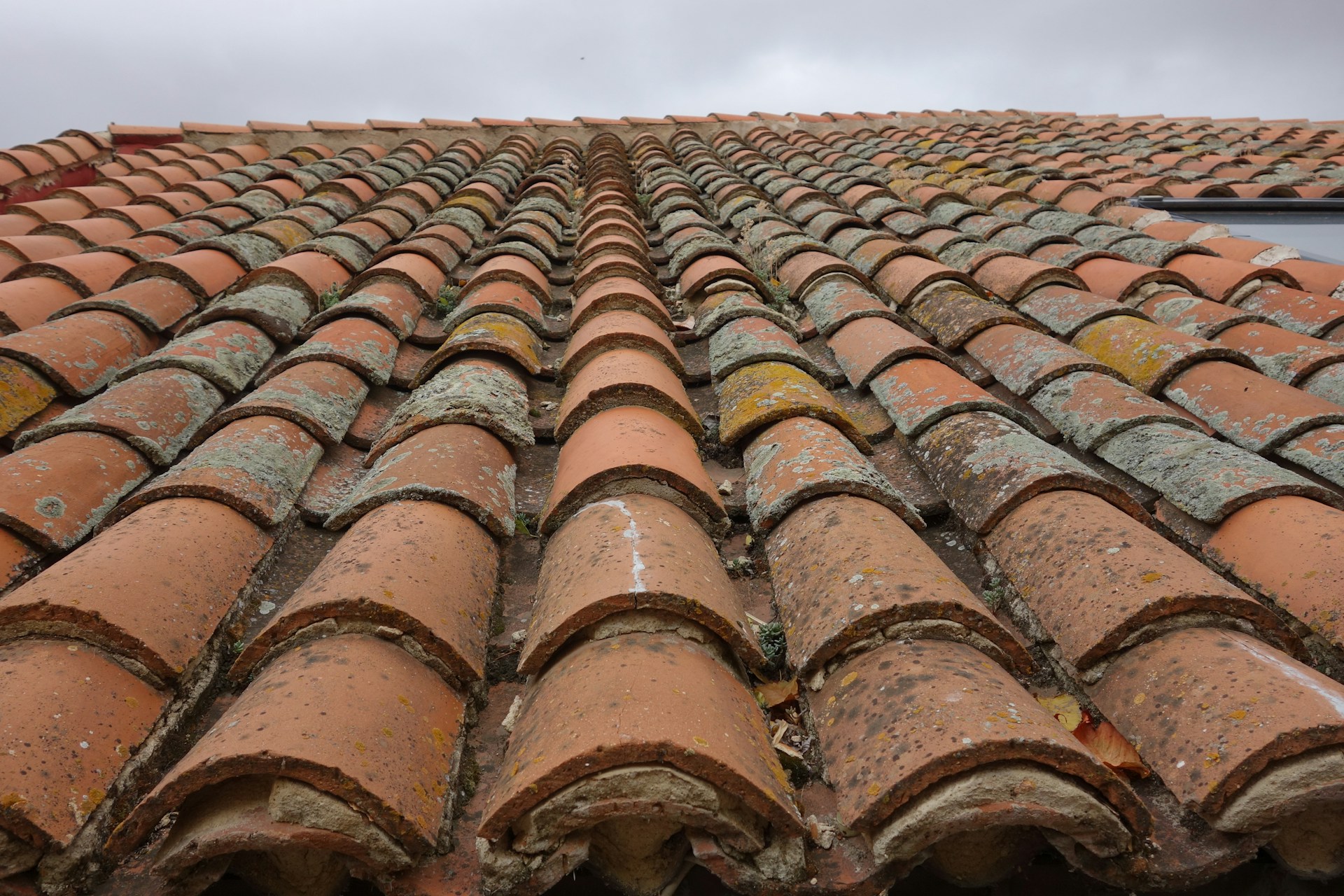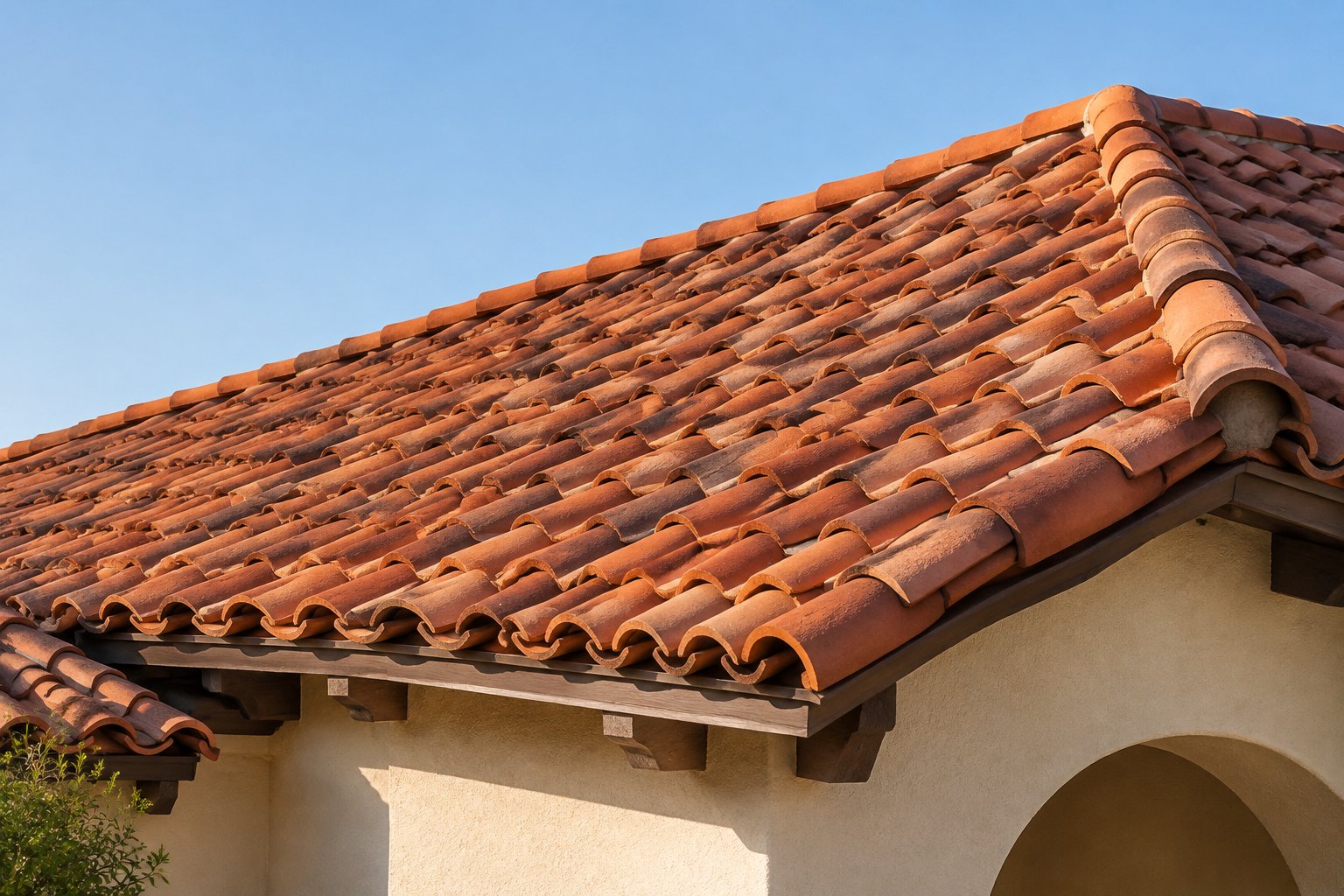
A mission tile roof is built from two separate clay pieces: a tapered pan laid concave-up, and a cover laid concave-down over the joint between pans. To repair, extend or restore one, you need two-piece tile that matches the existing taper, camber and color.
The profile drives everything else on the job. It sets your quantities, your dead load, your fixing method, and whether the finished repair reads from the street or disappears into the roof.
Salvage is usually the only reliable route to a period-correct match, because most pre-war profiles have not been made for decades. Old pans and covers also carry the firing marks and weathering of the roofs they came off, which is the part no new tile can reproduce.
Two-piece against one-piece S-tile
Two-piece mission tile uses separate pans and covers. One-piece S-tile combines both in a single fired unit. That difference changes how the roof sheds water, how it is laid, and which replacement tile will actually fit.
How tapered pans and overlapping covers move water
Each pan is a half-cylinder, wider at one end. Pans are laid concave-up in vertical rows with the narrow end pointing downslope, so each nests into the one below and water runs down the channel. Covers go concave-down over the gap between two pan rows, tapering and overlapping in the same direction.
The taper is what lets each course lap the next without creating a step. It is also why a pan from one source will not always nest into one from another even when the widths look close. Headlap depends on the taper, the tile length, and how far up the pan the next course sits.
Covers shed onto the pans and the pans carry water to the eave. If a pan is short, cracked or carries the wrong taper, water reaches the underlayment. The tile is the first barrier. The underlayment is the backup, not the other way round.
Why S-tile is not an interchangeable substitute
S-tile looks similar from the street but it is a different part. Its pan and cover are formed together, so the mold sets the rhythm of the roof. A two-piece roof has a looser rhythm because every pan and cover sits slightly differently.
You cannot drop an S-tile into a field of pans and covers. The lap, the side lock and the cover-line height will not line up, and if you force one in the patch reads as a flat uniform strip in a field that has depth and shadow. On a historic building that is a change of visible material and profile, which is exactly what a review board looks for.
What people mean by "Spanish" and "barrel"
The terminology is loose. Some sellers use "Spanish" to mean one-piece S-tile, others use it for any curved clay tile. "Barrel" often means the two-piece profile but listings are inconsistent.
Ask for the profile by its parts. Confirm separate pans and covers, then get length, width at both ends, and rise. A photograph of the underside settles most arguments. Our reclaimed Spanish barrel clay tiles are listed with those dimensions so you can compare them against your roof before committing to anything.
Coverage, quantities and load
Work out coverage from the tile you will actually install, then check the weight before anyone signs off the assembly. Printed specifications for new tile will not tell you how a salvaged batch lays.
Measure exposure and camber on the real batch
Exposure is the part of each tile still visible once the next course laps it. On mission tile that depends on length, taper and the headlap your installer intends to hold. Camber, the bow along the length, changes how pans nest and how much lap you lose to it.
Old tile was hand-formed or pressed in small runs, so two pans off the same roof can differ in length and curve. Lay several pans and covers from the batch on a flat surface, set them at the planned lap, and measure the actual exposure and row spacing. Do the same with tile from the existing roof. A table built around straight-bodied new tile will give you the wrong number.
Count pans and covers separately
Treat them as separate line items. Divide roof width by pan row spacing for rows per course. Divide rafter length by measured exposure for the number of courses. Multiply for pans. Covers usually run one row fewer than pans on each plane, or match the pan count where the edge detail demands it.
Then add for loss: cutting at hips, valleys and penetrations, breakage in handling and on the roof, culls you reject for fit once the crates are open, and spares left on site for future repairs. Salvaged clay needs a bigger allowance than new, and the overage has to come with the main batch. Pieces found months later rarely blend as well as tile from the same lot.
Count eave closures, rakes, hips and ridge pieces separately. Field-tile maths will not cover them.
Confirm the weight before you specify
Two-piece clay makes a heavy roof. Mud-set mission tile commonly runs 900 to 1,100 lb per square once you include the mortar. Batten-and-wire weighs less than a full mortar set, but the tile is still heavy.
If you are replacing a lighter roof, working on older framing, or dealing with long spans, get an engineer onto the rafters, deck and load path before you specify tile. Weigh a few pieces from the actual batch to firm the estimate up, and write the confirmed load into the drawings so the team has something to point at when an inspector asks.
Measuring up a mission roof and not sure what you are looking at? Call 225-954-8393 with photos and dimensions and we will tell you whether we can match it.
Details the contractor has to settle first
Fixing method, pitch, underlayment and flashing all need deciding before the tile ships, because they change what you order and cost time if they change later.
Mud-set against batten-and-wire
In mud-set work, pans and covers sit in mortar over the underlayment. It follows historic practice across much of the Spanish Revival and Mission-style south and west. It adds weight, and too much mortar blocks drainage under the tile.
Batten-and-wire uses wood battens or wire ties with nails or clips holding each tile. It weighs less, it is easier to service because tiles can be lifted and reset with less damage, and it leaves a drainage path.
On a restoration, match the original method unless the review body agrees otherwise. On new work, choose on weight limits, wind zone and local code. Tell us which method you are using when you order, because nail holes and fixing features on salvaged tile need to suit it.
Pitch, attachment and underlayment
Two-piece clay sheds through lap and gravity, so pitch has to suit the profile. Check the minimum slope in local code. On low-pitch planes, upgrade the underlayment or reconsider the profile entirely.
Wind zone sets the attachment rules, and many high-wind areas require mechanical fixing on every tile even in mortar-set work. Use corrosion-resistant fasteners that will outlast the underlayment cycle, because replacing a fastener means lifting the tile above it.
The underlayment is doing the real waterproofing. Use ice and water shield at eaves, valleys and penetrations where the climate calls for it, and specify something rated for the heat and service life of a tile roof. Asphalt-grade felt on its own is a poor choice under heavy clay.
Flashing and ventilation
On mission roofs, penetrations leak far more often than field tile does. Pipe jacks need a lead or soft-metal skirt that can be dressed to the curve of the pan. Chimney step and counter flashing has to be worked into the pan-and-cover rhythm, with a cricket on the high side of anything wide.
Vents need to suit the profile. A low-profile vent set into a curved field leaves gaps unless the body is made for barrel tile or the cover is cut and mortared to fit. Plan vent positions before layout so you are not cutting good pans at random. Use open metal valleys sized for runoff from both planes, and keep mortar out of the channel.
Why reclaimed clay matches and new clay does not
Reclaimed tile suits an old mission roof because it carries the evidence of earlier firing methods and decades of weather. New extruded tile has an even body and a clean face, and next to a weathered field it reads as exactly what it is.
Uneven firing and weathered surface
Historic kilns fired unevenly. Tiles near the flame came out darker, those further away lighter, and some picked up smoke shadow along one edge. A period roof is a blend of reds, oranges, browns and flashed tones rather than a single color.
Decades outdoors add lichen, mineral staining and a softened surface. None of that can be applied to new clay without looking applied. The National Park Service notes that a clay tile roof often defines the overall character of a historic building, which is why a mismatched patch pulls the eye so badly.
On Mediterranean and Spanish Revival work that variation is the whole point. Mix tiles from several crates as you lay them so the blend spreads across the plane instead of banding.
Match fit before you match color
Color gets the attention but fit comes first. A tile with the right color and the wrong taper will not nest, and it can lift the course above it. Check in this order:
- Length and width at both ends
- Camber along the length and rise across the curve
- Thickness at the edge
- Underside marks, nail holes and lugs
Maker's marks on the underside can tie a batch to the same plant and era as your roof. Pull tiles from several areas rather than one, because a single sample hides the variation. The approach in our guide to matching old tiles on a clay repair applies directly to mission work.
Tell patina from damage
Weathering is fine. Damage is not. A sound tile rings when tapped and a cracked one sounds dull. Hairline cracks hide under lichen, so check the underside and the edges rather than trusting the face.
Look hard at nail holes and lugs. A tile with a blown-out hole or a snapped lug may not hold in batten-and-wire work, though it can still go down in mud-set with proper bedding. Reject anything with deep spalling or surface loss that exposes the body, because it will take on water.
Everything we ship is culled for these faults before crating, but check a sample when the crates land and before the tile goes up.
Secure the fittings before the field tile
Hip and ridge pieces, eave closures and rake fittings are the hardest items to find twice. Roofs used fewer of them and more get broken during strip-out, while field tile turns up comparatively easily.
Lock the fittings down first, then buy field tile to match. Do it the other way round and you can end up with a visible mismatch running along every ridge line. Count ridge length, hip length and terminal pieces before ordering, and ask for photographs of the fittings in the batch. Period-correct matching lives or dies on the trim as much as the field.
What drives delivered and installed cost
Delivered material cost comes down to the batch, its usable yield, the fittings and the freight. Installed cost adds labor, access, mortar and any structural work.
Price per tile tells you very little until you know how much roof the batch covers. Long, wide pans cover more area and you need fewer of them. Short or heavily cambered tile takes more pieces per square. Fittings usually cost more per piece than field tile simply because they are scarcer.
Two-piece tile also takes more labor than one-piece, because the crew is setting pans and covers separately, and mud-set adds mixing and bedding time on top. Steep pitch, roof height and tight sites push staging costs up further. If an engineer calls for sistered rafters, new decking or added connections, price that before the roof goes out to bid, because it can exceed the material cost.
One note on warranties: new tile is sold with manufacturer terms that do not transfer to salvaged material, whatever its shape. A reclaimed tile's track record is the roof it came off. Set client expectations on tile condition, sound testing and the quality of the new underlayment and installation instead. If a lender or code body wants product approvals for a high-wind area, raise that before you commit to reclaimed tile rather than after.
Put the profile in writing before you order
Nail down the profile, sizes and fittings in writing and you avoid almost every mismatch that happens on these roofs.
Send pan and cover length, width at both ends, rise and thickness. Include photographs of the field, the underside, and every hip, ridge and eave detail, using tiles from several areas of the roof. State whether the job is mud-set or batten-and-wire. Give the square count from your measured exposure, plus overage. For a historic building, the Secretary of the Interior's guidance calls for retaining roofing material such as clay tile that defines the building's character, which means matching profile as well as color.
Confirm the load with your engineer, settle flashing and vents, and secure the fittings before ordering field tile. If you are writing the specification rather than laying the roof, our specification support covers the documentation that holds up in review.
We sell builder-direct from our yard in Baton Rouge with no retail counter in between, ship crated and palletized nationwide, usually within 3 to 7 business days of confirmation, and send batch photographs for approval before anything leaves. Call 225-954-8393 with your measurements and photos for current availability and a delivered price.
Frequently Asked Questions
Can reclaimed mission tile cover a full roof, not just a repair?
Yes, provided the batch covers the square count, the overage and the fittings. Confirm quantities and review photographs of the whole lot before ordering, and mix across crates during installation so color stays even across the plane.
Can one-piece S-tile replace broken two-piece mission tile?
No. The lap, side fit and cover height do not line up with separate pans and covers. Use two-piece tile with the same size and camber.
How long does a reclaimed clay mission roof last?
The tile can last 75 to 100 years or more. The underlayment and flashing will need replacing on their own schedules within that. Most clay roofs described as failed still have good tile sitting on a failed substrate.
What are the drawbacks of a two-piece mission roof?
Weight and labor. Mud-set two-piece clay commonly runs 900 to 1,100 lb per square, and setting pans and covers separately takes longer than one-piece tile. Trim fittings can also be hard to source again.
Can existing mission tiles be reused when the underlayment is replaced?
Yes, and it is standard practice. Lift, stack and relay the sound tile over new underlayment. Have matched replacement tile on site before anything comes off, because some breakage is certain.
What do you need from me for a delivered quote?
Pan and cover length, width at both ends, rise and thickness. Roof area in squares plus linear feet of hip and ridge. Photographs of the field, underside and trim pieces, and your delivery ZIP code.