Moss on a clay roof usually turns up as a scheduling question halfway through a project. Clean it, leave it, or price repairs in, all without breaking tiles you might not be able to replace.
The rule that covers most roofs: light lichen on sound clay is cosmetic and can stay. Thick moss that holds water or blocks drainage comes off by dry hand brushing. No pressure washer, no wire brush, no harsh chemicals.
The harder part is everything around the moss. Telling surface growth from a real defect, protecting the fired face, and having matched tile on site before anybody steps on fragile courses.
When moss needs action
When it holds water against the tile or changes how water drains off the roof. Below that, growth on clay is a question of appearance, and on a period building an aged roof is part of its value. The National Park Service describes historic clay tile roofs as inherently fragile and asks for special care during any work on them, so the threshold for touching one should be high.
Moss also tells you about the site. It marks where shade falls, where water lingers and where debris collects, so read it as a map before deciding what to treat.
Lichen or moss
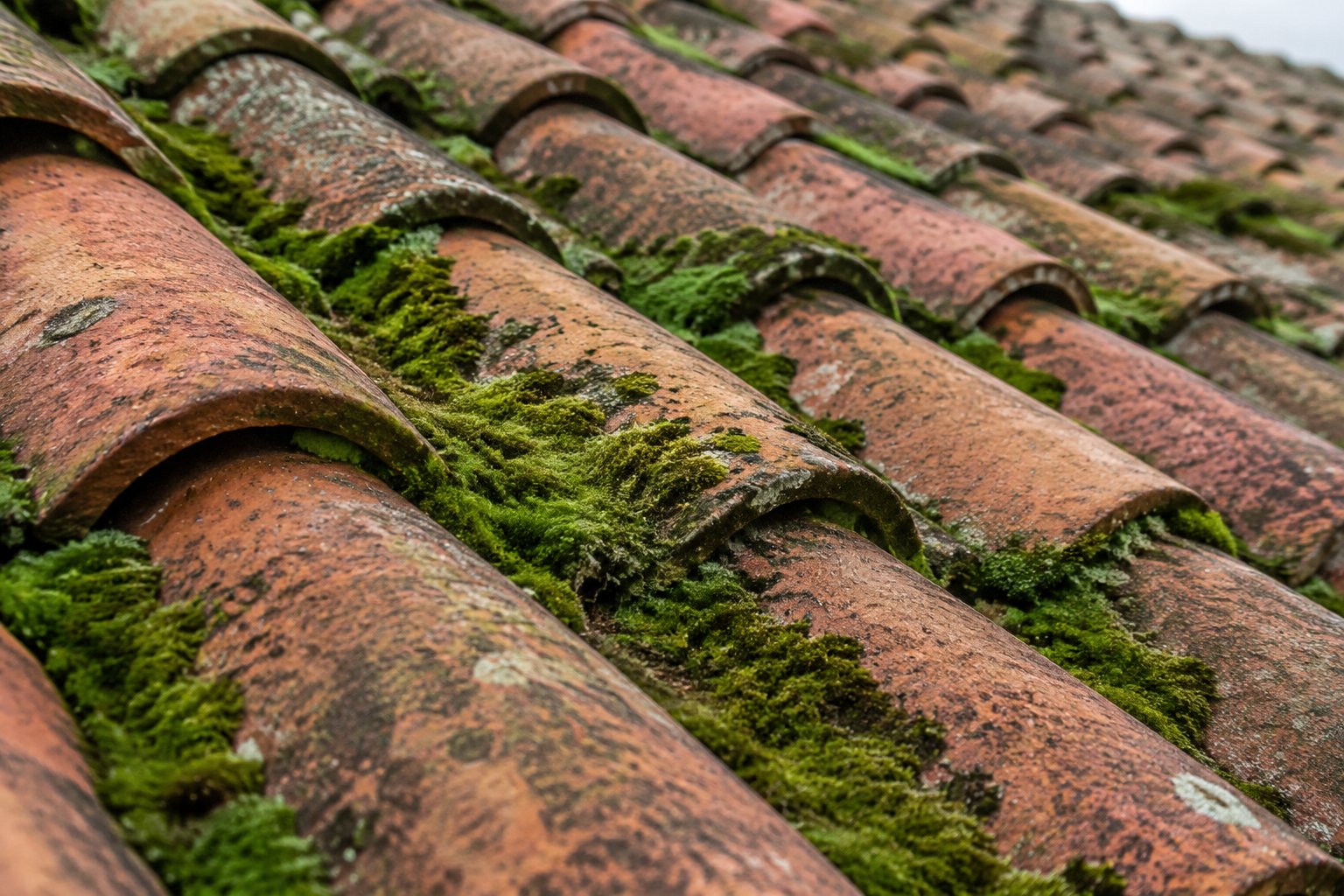
Lichen forms a thin crusty layer clinging to the tile face. It holds very little water, lifts no tiles and fills no joints. Review boards and owners usually want it left exactly where it is, because it is part of the weathered color no new tile can match.
Thick moss builds cushions that behave like sponges, rooting into the laps and the gaps between pan and cover, and trapping grit and leaf litter that feed more growth. If a cushion still holds water after a dry day, it has stopped being cosmetic. Leave the lichen, target the moss.
What retained water actually does
Clay sheds by gravity, each course passing water to the one below and on to the gutter. NAHB puts the basic requirement plainly: exterior water needs a path from the roof to the foundation so it drains away from the building.
Heavy moss interrupts that path. It dams water at the head laps and side joints, pushes it sideways, and can send it back under the tile toward the underlayment. In valleys and at the eaves, moss and debris together slow runoff enough to overflow onto battens and fascia. The tile is often fine. The problem is where the water is now sitting.
Freeze-thaw changes the urgency
In cold climates, wet moss turns a moisture problem into a breakage problem. Water held against the tile soaks into the clay body and expands when it freezes, and across enough cycles it spalls the face and cracks the tile, soonest on softer or more absorbent clay.
A roof on the Gulf Coast can carry moss for years with little tile damage. The same roof in a northern climate with dozens of freeze-thaw days each winter is on a different timetable. In freeze-prone areas, treat thick moss as a near-term job. In mild damp regions you have room to plan it properly.
Removing it without damaging the clay
Work dry, work gently, and keep your weight off the tile. One test applies to every method: does it take the growth off without harming the fired surface or the fixings? NPS cleaning guidance for historic fabric asks for the gentlest means possible, which suits clay tile exactly.
Assess and plan access first
Inspect from the ground, the ladder and the attic before anybody walks the field, looking for slipped tiles, cracked noses, missing covers and staining under the deck. Note which slopes carry the heaviest growth and mark anything already loose or broken.
Access decides how many tiles you break. Plan walk boards or foam pads and route traffic along hips and supported areas. Profile matters as well, since two-piece pan and cover, one-piece S-tile and flat shingle tile each break in different places, so establish the clay tile profile before the crew goes up. Stay off clay in cold weather, when it is at its most brittle.
Dry brushing
Dry moss comes away far more easily than wet, so wait for a dry spell. Use a stiff nylon or natural-bristle brush or a plastic scraper, and work downslope with the laps, because brushing upslope lifts tile edges and drives debris into the joints.
Take the bulk of each cushion off and leave the thin film. A light green trace is fine and dies back on its own once the thick growth has gone and the surface dries faster. Clear the loosened material out of valleys and gutters the same day, or it washes straight back into the drainage path you were trying to clear.
Why pressure washing wrecks clay
The jet strips clay's fired surface and shortens tile life. It erodes the weathered face, opens the pores, and drives water under the courses into the underlayment. On a historic roof it also blasts off the patina that makes the roof read as original, which is not recoverable. Even a low-pressure soft-wash rig puts water where it does not belong if the operator aims upslope.
Wire brushes scratch the face and leave steel fragments that rust-stain the clay. Metal scrapers chip edges and nibs. Prying moss out of joints with a flat bar cracks covers and loosens fixings. Any of those turns a cleaning job into a repair job, and on a discontinued profile that is a considerably more expensive job than the one you started with.
Cleaners, planting and runoff
Read the label before anything goes on clay. Some products rule out tile outright: one EPA-registered moss product warns users not to use it on tile, brick or concrete because severe staining can occur, and notes that it corrodes galvanized metal. A stain on fired clay is permanent.
If you do use a cleaner, test it on one tile on a hidden slope first. Apply at low volume with a pump sprayer and keep it off flashings and gutters it could corrode. Cover shrubs and beds under the eaves and wet them down before and after, and think about where the runoff goes, because anything that kills moss on a roof will do the same to planting below it.
Worried a cleaning job will cost you tiles you cannot replace? Send photographs and measurements and we will tell you whether we can match the profile. Call 225-954-8393.
Why it comes back on some slopes
Moss returns where the roof stays wet longest, so regrowth is a site condition rather than a defect in the clay. Cleaning without changing the conditions just resets the clock.
Shade and region
North-facing slopes get little direct sun and dry slowly after rain or dew, and slopes under trees or beside taller buildings behave the same way. Those areas grow moss first and grow it back first.
The region sets the baseline. The Pacific Northwest, coastal New England and the humid Southeast all give moss a long growing season, while in dry Western climates the same tile on the same pitch may never carry more than a little lichen. Set the owner's expectations from the local climate and the slope's exposure rather than from a general cleaning interval.
Debris in the valleys
Valleys collect needles, leaves and seed pods, and that debris holds water and breaks down into soil that moss roots into immediately. The same happens behind chimneys and dormers, and anywhere the side laps on interlocking clay tiles catch grit.
Once a valley slows down, water backs up and spreads into the tiles either side, widening the wet zone and the moss zone with it. Heavy regrowth in a valley is a debris problem before it is anything else.
Moss is not an attic ventilation diagnosis
Some reports treat exterior moss as proof of poor attic ventilation. On clay tile that connection is weak, because tile sits on battens or a deck with its own air space and rain, dew and shade account for most of the surface moisture.
Ventilation problems show up inside: condensation on the deck, damp insulation, mold on framing. EPA guidance is to control mold by controlling moisture, which means tracing it to the actual source. Check the attic on its own terms, and do not specify vent changes because the north slope is green.
Maintenance that keeps it down
Help the roof dry quickly and drain freely. Nearly all of that work happens at the edges, with very little foot traffic on the tile itself.
Gutters, downspouts and valleys
Gutter cleaning is the single most useful task for moss control. Full gutters hold water at the eave course, keep the bottom tiles wet and give moss a base to climb from. Once a year, or twice under deciduous trees.
Clear valleys from a ladder or roof hook where you can reach them, flush the downspouts to confirm they run, and check that debris has not packed behind ridge and hip fittings or along chimney crickets.
Vegetation and drying
Cut back branches hanging over the roof, which reduces the leaf supply and opens the slope to sun and wind. Even a few feet of clearance shortens the drying time after rain measurably.
On sites where the owner values the trees, that is a trade-off rather than an instruction. Where the shade stays, accept that the slope needs cleaning more often and write it into the maintenance plan so nobody is surprised in three years.
Zinc and copper strips, honestly
Strips near the ridge release metal ions into rainwater and slow growth downslope. They work best in the first several feet below the strip, do less further down a long rafter run, and do very little on a slope that stays shaded and wet all day.
Fix them under a course or to the ridge without punching through sound tile. Keep copper runoff away from aluminum gutters and galvanized steel, expect some staining below copper over time, and check whether a review board will accept visible metal on a historic roof before you fit it.
Inspection intervals
Once a year in most climates, plus a check after major storms. In damp, shaded or freeze-prone areas, add a spring inspection to catch winter damage and new growth early.
Work from the ground, the ladder and the attic, recording slipped tiles, flashing gaps, mortar loss at hips and ridges, and moss coverage. Photographs from the same positions each year show whether growth and wear are accelerating, which is far more useful than any single survey.
When cleaning is not the answer
When the moss was hiding damage, or the roof has stopped working underneath. At that point it is a repair, and the material plan comes first.
Sort the defects
Once the moss is off, look at what was under it. Cracked or spalled tiles, broken nibs, slipped courses and rusted fixings are material and fastening problems, and no amount of brushing addresses any of them.
Stains on the deck or ceiling almost always trace to underlayment, valley metal or flashing rather than the tile. A clay roof that looks failed is often sound tile over a failed substrate. Separate the defects into tile, fixings and the layers beneath before anybody prices the job.
Repair what failed
Isolated cracked tiles need those tiles replaced, not a new roof. Replacement earns its place when the underlayment has failed across the roof or the fixings have gone widely, and even then the sound clay goes back down over the new substrate.
Count the broken tiles slope by slope and separate isolated damage from patterns that point at a wider failure. The Secretary of the Interior's Standards call for retaining and preserving roofing material such as clay tile where it defines historic character, and on historic roof restoration work that is usually also the cheapest route.
Get the match before you disturb anything
A tile broken during cleaning or access can be hard to replace, so the matching tile wants to be on site before the crew lifts anything or crosses a fragile slope, with extra to cover breakage nobody can predict.
Match profile, size, camber and weathered color. Photograph tiles on several slopes in overcast light, measure length and width, and photograph the underside for maker's marks. Our guide to matching old clay tiles for repair goes through it in detail, and where nothing on the shelf fits, our custom sourcing works the salvage network for the profile.
Preserve sound clay and keep water moving
Treat moss as a drainage and shade issue. Leave light lichen, which protects the aged look and holds almost no water. Remove thick moss where it holds moisture, blocks laps and valleys, or sits on a freeze-prone roof.
Brush dry and downslope with nylon bristles, clear gutters and valleys, and plan the access properly. Keep pressure washers, wire brushes and unlabeled chemicals off the tile entirely. Trim what you can, fit zinc or copper if it suits the building, and inspect yearly. Where cleaning uncovers cracked tile or failed fixings, repair those and keep the sound clay.
We supply reclaimed clay roof tiles salvaged from historic American roofs, hand-inspected and sounded before crating, shipping typically 3 to 7 business days after confirmation. We supply the tile and your contractor does the work. Call 225-954-8393 for current availability and a delivered price on matched clay tile for your project.
Frequently Asked Questions
Is it fine to leave a little moss or lichen on clay roof tiles?
Yes. Thin lichen and light moss films hold very little water and do no harm to sound clay. Remove growth once it forms thick cushions, fills joints or slows drainage, and act sooner in freeze-thaw climates.
Does dish soap kill roof moss safely?
Dish soap is not labeled as a moss killer and does little against established growth. A mild soap solution will not etch fired clay, but rinse at low pressure, protect the planting, and keep runoff out of beds. Dry brushing does far more of the work.
What does professional moss removal from a clay tile roof cost?
It depends on roof size, pitch, height, access and how much growth there is, and breakage can add replacement tile to the bill. Get a written scope that rules out pressure washing, and line up matching tile first so a repair does not stall the job.
How soon does moss come back after cleaning?
On shaded damp slopes, visible regrowth inside one or two growing seasons. Sunny well-drained slopes stay clear much longer. Trimming, clearing valleys and fitting zinc or copper strips all stretch the interval.
Can moss come off without stripping the historic patina?
Yes. Brush the tile dry with nylon bristles and stop once the thick growth is gone. Leave the lichen and light staining, which are part of the weathered color. Pressure washing and wire brushes take the patina off for good.