The ridge takes more wind, sun and water than any other course on a slate roof, and it is usually the last detail anybody thinks about. That order gets jobs into trouble, because ridge pieces, thickness and fixing method all affect what needs to be on the order and when it ships.
For most natural slate roofs the answer is a slate saddle or comb ridge cut from the same batch as the field slate. Copper or lead-coated copper takes over where you need a ridge vent, a very long run, or the steadiest weather protection on a roof nobody wants to climb often. Settle it before the field slate ships.
Which ridge detail suits the roof
Age, pitch and ventilation decide it. Saddle and comb ridges keep the roof all slate. Metal ridges trade a little period character for continuous cover and straightforward venting. On historic work, start from the original detail, since preservation guidance treats the pattern and detailing of a slate roof as design elements worth keeping.
Saddle ridges
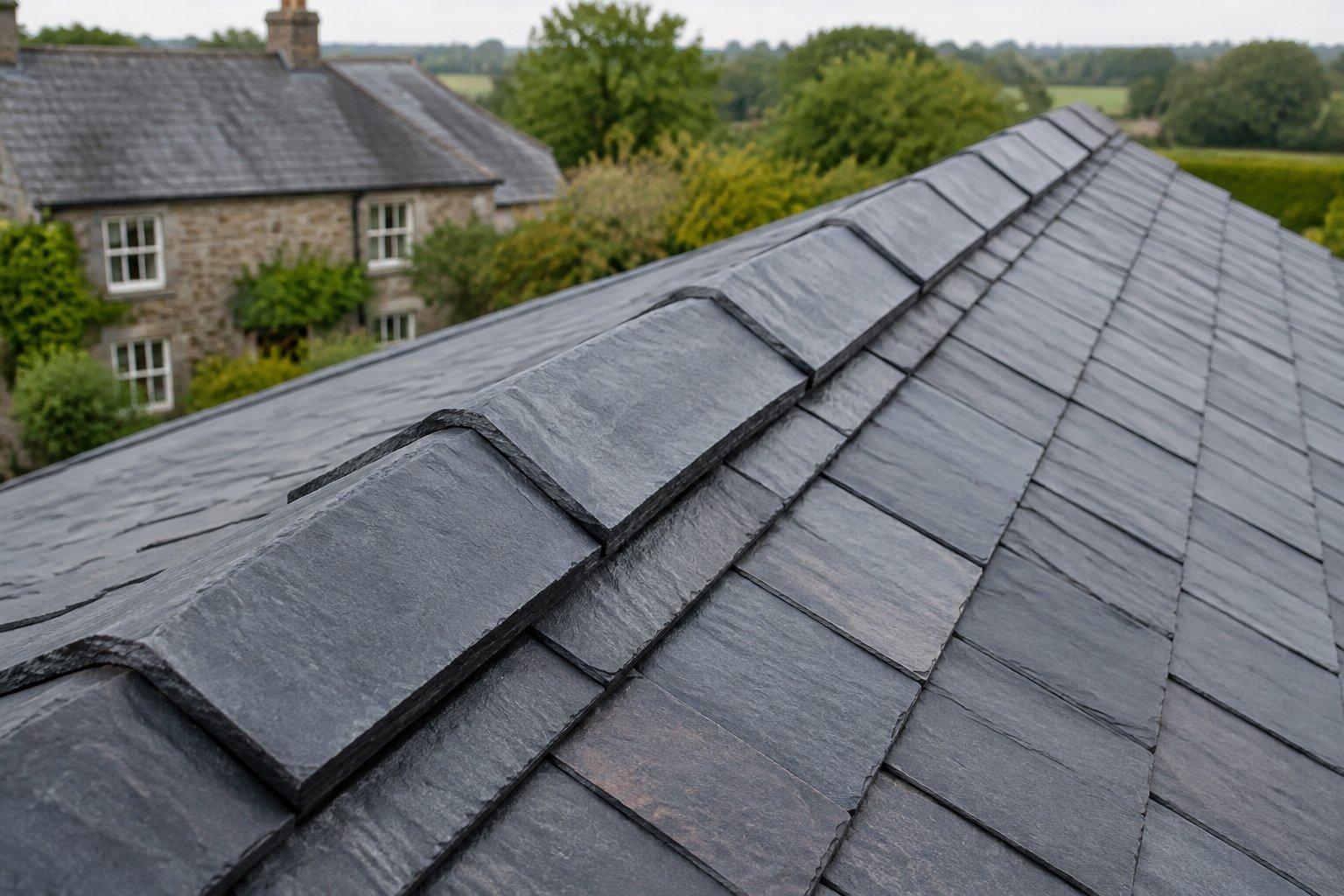
Ridge slates laid in pairs, one each side of the apex, meeting at the top, each pair lapping the one before it the way the field courses do below. The butt joints at the apex alternate side to side so no seam runs straight down the ridge.
A saddle ridge reads as part of the roof, which suits Colonial Revival, Georgian and plain gabled houses where a clean line matters. Water sheds well as long as the pieces fit tightly. The weak point is the apex joint, because once it opens, water reaches the nails in the top course.
Comb ridges
One side's top course carries past the apex and stands up like the teeth of a comb, with the other side butting tight beneath it. The projecting side has to face away from the prevailing wind so rain passes over the joint rather than blowing into it.
It gives a sharp line and turns up on Gothic Revival, Tudor and steep church roofs. No separate cap pieces, but the top course needs careful cutting. Facing it the wrong way is the classic error, and a comb ridge set into the wind drives water straight into the joint in the first real storm.
Copper and lead-coated copper
A formed metal cap running the full length of the apex, covering the top courses both sides in one continuous run with lapped or soldered joints. Copper weathers brown then green. Lead-coated copper settles to a soft gray that sits well against gray or black slate.
Metal earns its place where you need a vented ridge, a long run, or low maintenance on a roof that is hard to reach. Copper keeps pace with slate, which preservation guidance puts at 60 to 125 years or longer depending on type. Plan formed caps, cleats and vents in with the rest of your slate roofing accessories when the slate order goes in.
How they compare
For pure weather protection, copper gives the most continuous cover, with saddle ridges behind it and comb ridges performing well only when they face the right way. Saddle and comb keep the roof all slate, which review boards tend to prefer, though copper suits plenty of period roofs too, so check old photographs or the nail pattern before ruling it out.
On upkeep, slate ridges need their joints and fixings checked and cracked pieces replaced with matching slate. Copper asks for almost nothing as long as it was fixed so it can expand. Choose the detail you can install properly and keep tight on that particular roof.
Pitch, dimensions and ventilation
Pitch sets the ridge size. The ventilation plan decides whether the ridge stays closed or becomes an exhaust. Both change the parts list, so both come before the order.
Sizing to the pitch
Slate overlap depends on the slope of the roof, and the ridge follows the same logic. On a low pitch, water moves slowly and wind pushes it further under the laps, so use wider ridge slates or a wider metal cap to keep the top-course nails covered.
On a steep roof the ridge angle is sharp and a saddle pair sits close together, so narrower pieces work, but the apex joint has to be tight because there is less room for error. Measure the pitch on both sides. Older houses regularly have unequal pitches, and then the ridge slates want different widths left and right.
Thickness, support and transitions
Thick slate raises the top course and widens the gap at the apex, so ridge pieces need to match the field slate's thickness for the saddle to sit flat. A thin ridge slate on a thick field rocks, cracks and opens the joint. Check reclaimed slate sizes against your field slate before you settle the ridge width.
Support matters as much as thickness. A ridge board or solid blocking at the apex gives the top course and the ridge nails something firm to hold. Plan the transitions where the ridge meets a hip, a chimney or a gable end, because those need saddle pieces cut to fit or a metal boot, and they are where ridges open up first.
When a ridge vent belongs there
When the attic is ventilated and has soffit intake to feed it. Never on an unvented insulated deck, where venting the top pulls moist air in and causes condensation.
On slate, the practical way to vent is a copper or lead-coated copper cap over a raised vent with baffles and a screen. Saddle and comb ridges are closed details by nature. Where you want slate on top and ventilation as well, a low-profile vent at the ridge under slate cover can work, provided it suits the period of the house.
Balancing exhaust and intake
Exhaust does nothing without matching intake. Balance the net free area at the ridge against the soffit intake, or the vent will draw air through ceiling leaks instead, which moves moisture from the house into the roof. Keep eave baffles clear so insulation does not block the path.
Specify a vent with an external baffle and an insect screen, and lap the deck opening so any water getting past the baffle drains back onto the slate. Stop the ridge cut-out short of the gable ends and hips so the vent does not run into those joints.
Not sure what the existing ridge was? Send photographs and your measurements and we will help you read it. Call 225-954-8393.
Fixing and bedding
A reliable ridge holds each slate flat with the right nails and lets metal move freely. Nearly every ridge failure starts with a slate under stress, the wrong fastener, or a cap that cannot expand.
Support the slate properly
Ridge slates sit flat on the course below with even support along their length, so shim or plane the ridge board rather than letting pieces bridge a gap. A slate resting on one high spot cracks the first time somebody steps nearby or heavy snow settles on it.
Keep nail holes well in from the edges, drill or punch from the bed face so the spall shows on top, and set nails so the head just touches the slate. Driving them hard puts the slate in tension and cracks it, and at the ridge there is less room to get away with it than anywhere else on the roof.
Fasteners and concealed attachment
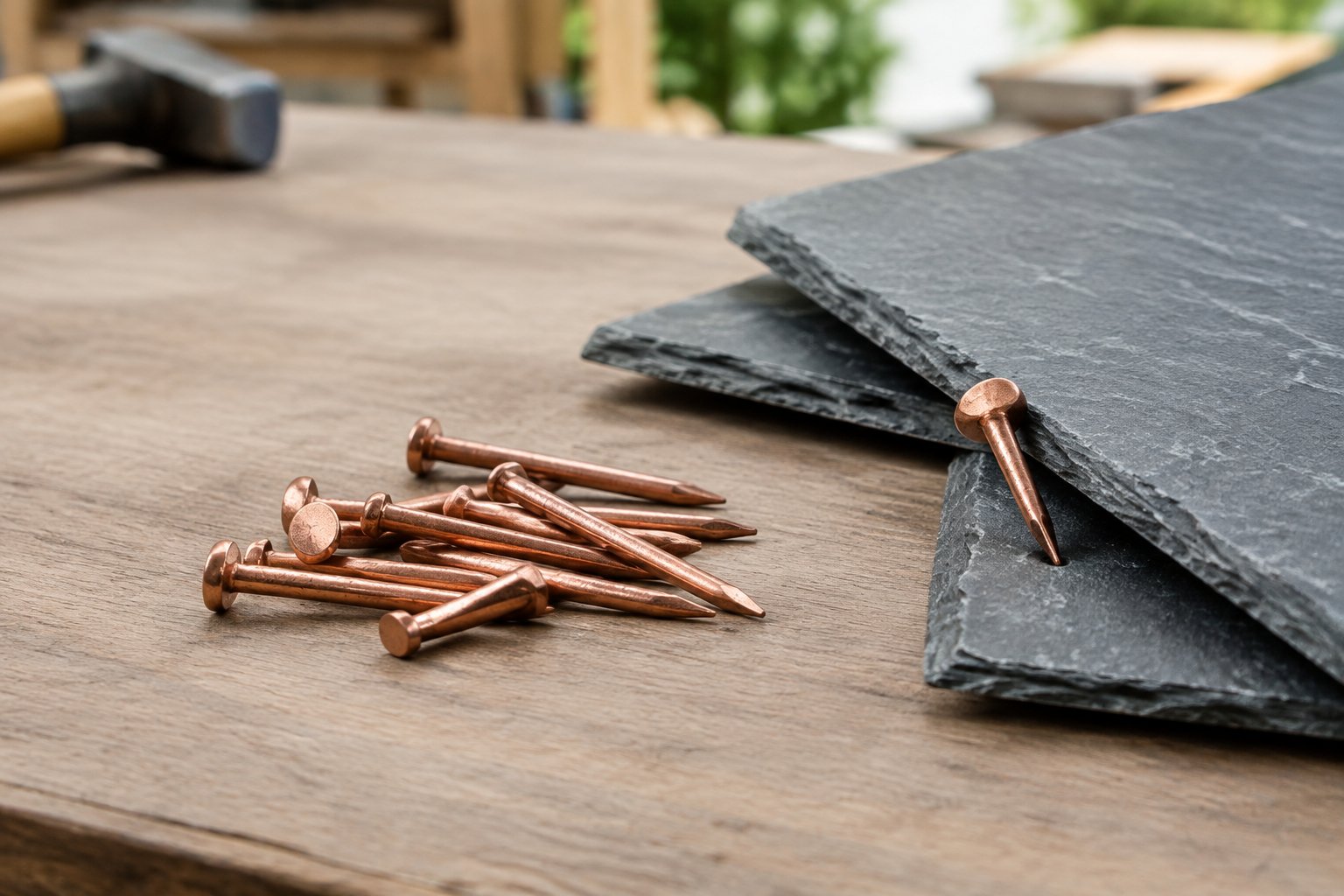
Copper or stainless at the ridge. A slate normally takes two nails driven through prepunched holes, and ridge pieces are no different. Galvanized steel corrodes long before the slate wears out, and replacing failed nails up there means lifting sound slate to get at them.
Keep the metals compatible: copper nails, cleats and solder with copper caps, and nothing galvanized or aluminum in contact with copper. Hide the fixings where you can. On a saddle ridge the next pair laps over the previous pair's nails. On a metal cap, use concealed cleats rather than face nails.
Bedding and joints
Bedding fills gaps, it does not carry load. On a slate ridge, a small bead of sealant suited to slate and copper at the apex joint, under the lap, kept thin and hidden. Heavy smears of roofing cement across the face crack, trap water and look wrong from the ground.
Some regional work beds ridge slates in mortar. Where you follow that, use a lime-based mix with some flexibility left in it and set the slate on a firm even bed. Hard cement mortar shrinks and cracks away from slate inside a few winters. On a metal ridge, rely on the laps, cleats and baffles instead of sealant.
Let the metal move
Copper expands and contracts every day the sun hits it. Fix a long run rigidly and it buckles, tears at the joints, or pulls nails through the slate. Use loose-lock or lapped joints at set spacing and clip the cap with cleats that let it slide.
Never nail through the cap into the slate below, which pins the metal and cracks the slate as the cap works. Leave a small gap at gable ends and hip junctions, and on very long ridges plan proper expansion joints and flash them so water still sheds over them.
Why badly repaired ridges leak
Because the repair covered the problem instead of rebuilding the detail. Cement, exposed nails and mismatched slate all fail fast in the most exposed position on the roof.
Cement, open joints and face nails
Tar and roofing cement are the most common ridge repair there is. They hold for a season or two, then dry, shrink and crack, and water sits behind the patch. The cement also makes the slate close to impossible to lift and reuse later, which turns a repair into a replacement.
Open apex joints and face-nailed ridge slates come next. A nail through the exposed face with a dab of sealant over it leaks the moment the sealant goes, and every exposed nail is a hole in the deck. A proper repair lifts the slate and refixes it so the following piece covers the nails.
Cracks, loose caps and wind-driven rain
Foot traffic, overdriven nails and hard landings during other trades' work crack ridge slates, and a thin crack across a saddle piece lets water straight through. Loose metal caps rattle, work their cleats free and lift at the laps.
Wind-driven rain finds all of it, pushing water up and sideways under laps that handle ordinary rain without trouble. That is why a ridge stays dry for months and then leaks in one storm from one direction. Note the wind direction when the leak appears, because it tells you which side failed.
Leak or condensation
A leak shows during or just after rain and follows the storm's direction. Condensation shows in cold weather, often on clear nights, spreading as damp or frost across the underside of the deck near the top.
Check the attic. Rust on nail points, wet stains near the ridge board and frost on sheathing all point to moist air from the house, and a ridge vent added without enough intake, or a vented insulated deck, will do it. Fix the airflow first, because relaying the ridge will not stop condensation and you will have spent the money for nothing.
Local repair or rebuild
Repair locally where a few cracked pieces, a short open joint or a loose length of cap caused it. Lift the damaged slates, clear the old cement off, refix with copper or stainless nails and matching slate. That is the same principle as any slate roof repair: replace what failed, keep what is sound.
Rebuild the whole ridge where nails have rusted along its length, cement coats it, or a lot of slates have cracked. Slate can run up to 150 years, so a ridge rebuilt with sound fixings and matched slate should outlast several patch cycles and cost less across that span than any of them.
Matching and ordering reclaimed ridge material
Order ridge and hip slate with the field slate, out of the same batch wherever possible. Ridge pieces are scarce and a late search usually ends in a mismatch along the most visible line on the roof.
Take ridge stock from the field batch
Pull ridge and hip slates from the same batch covering the field, choosing flat sound pieces thick enough to cut without splitting. Long wide slates suit the ridge best because they can be trimmed to width.
Because our batches are sounded and culled by hand before they ship, you start from slate that rings true with no hidden cracks. Set the ridge stock aside before the field crew starts laying, or it ends up on the slope and you are short at the top.
Color and thickness
A ridge cut from a different batch stands out along the roof's highest line, where color shifts and weathering differences read clearly against the sky. Thickness differences are worse than cosmetic, because they make saddle pairs rock and open the apex joint.
Match the weathered face, never a fresh break, and compare several pieces in overcast light. For grays, purples and blends, the method in our notes on specifying the right slate color match applies at the ridge too. On historic buildings, preservation standards ask that replacement features match the old in composition, design, color, texture and, where possible, material.
Order the scarce pieces first
Salvaged ridge pieces are harder to find than field slate, because fewer long sound slates come off an old roof and pre-formed slate ridge pieces are rarer still. Order field slate now and look for ridge stock later and the batch may well be gone.
Put ridge and hip quantities on the same order as the field slate, along with any copper caps, cleats or vents, so everything lands together. Our orders ship crated and palletized, typically 3 to 7 business days after confirmation, and one complete order is what keeps a crew from waiting on the top course with the scaffold still up.
What to send, and what to budget
Measure the ridge and each hip in linear feet, note the pitch on each side, the slate length and thickness, and the exposure you intend to use. For a repair, measure a few existing ridge slates and photograph them from several areas of the roof.
We send batch photographs for review before an order is confirmed, and since reclaimed slate is final sale, that review is your check. Allow extra for cutting and breakage, because ridge pieces take more trimming than field slate, and the right allowance depends on the batch and the roof.
Keep the budget in separate lines: slate by batch and size, fabrication for cutting pieces and forming or soldering copper, freight to the jobsite with liftgate if needed, and installation, which is slow careful labor at height with staging behind it. Split out that way, quotes are comparable and you can see where the money actually goes.
Specify the ridge with the field slate
Write it into the same specification: the detail, saddle, comb or copper, the fixing type, the bedding method, and whether the ridge is vented. A vague "ridge to match" note hands the decision to whoever happens to be on the roof that day.
Tie the ridge stock to the field batch so color and thickness agree, and size it to the measured pitch. Copper or stainless nails, bedding light and hidden, and any metal cap free to move. On historic buildings, establish the original detail before choosing, because historic roof restoration approvals often turn on exactly that.
We cull and sound every batch by hand, supply ridge and hip stock alongside the field slate, and will work a match from a physical sample through our slate matching service if you would rather not judge it by eye. We supply material and do not install it. Call 225-954-8393 for current availability and a delivered price on field and ridge slate.
Frequently Asked Questions
Does a slate roof need a ridge cap?
Yes. Every slate roof needs a finished ridge to close the gap where the two slopes meet, whether that is a slate saddle, a comb ridge or a copper cap. Without one, water runs straight into the top course and the ridge board.
Can a dry ridge system go on a natural slate roof?
Dry ridge systems suit modern tile and new slate laid to standard gauges and rarely fit reclaimed or historic work. They change the ridge's appearance and do not cope well with random-width slate. On a period roof, a slate ridge or a properly fixed copper cap is the better answer.
Do slate ridge caps come in standard sizes?
Some pieces come cut to common sizes, but reclaimed work almost always means cutting ridge slates to suit the pitch and the field thickness. Unequal pitches and varied thickness make every ridge slightly different, so measure the roof and match the ridge stock to the field batch.
Can a copper cap replace an existing slate ridge?
Yes, and it is the usual choice when a ridge vent is being added. On historic or reviewed buildings, confirm the change suits the period first, and fix the cap with cleats so it can expand.
How much does slate ridge cap replacement cost?
It depends on ridge length, pitch, height, staging, the detail chosen and whether matching slate is available. Price material, fabrication, freight and labor as separate lines, and call 225-954-8393 with your measurements for a delivered material price.
Can the ridge be replaced without touching the field slate?
Yes. A roofer lifts the top courses, repairs the ridge board if it needs it, and refixes new or salvaged ridge pieces with the field slate left in place. Match the replacement to the existing field so the new ridge blends in.