A leak, a handful of cracked tiles, and a clay roof made to a profile no factory has produced since the 1930s. The repair has to hold and it has to disappear from the street. Both of those depend on work done before anybody lifts a tile.
Identify the profile and how it is fixed. Measure it. Then find the match. Taken in that order, a Spanish tile repair is straightforward. Taken out of order, it turns into a patch everybody can see from the sidewalk.
Which profile and fixing system are you repairing?
People use "Spanish tile" loosely for several different clay systems. Two roofs that look alike from the curb can need completely different replacement tiles.
One-piece S-tile against two-piece pan and cover
A one-piece S-tile combines pan and cover in a single fired piece, reading as a wave from the ground, each tile lapping the one beside it and the one below.
A two-piece system uses a tapered pan laid concave-up with a cover laid concave-down over the joint between pans, usually called mission or barrel tile. Deeper shadow lines, more irregular rows. Interlocking and flat clay are also in use on American roofs of the same era, so rule those out early rather than assuming.
Why similar profiles are not interchangeable
S-tiles and barrel tiles do not mix. An S-tile cannot sit in a pan-and-cover field without gapping at the side laps, and a barrel cover will not seat over an S-tile's built-in roll.
Two barrel tiles of the same length may still not match. Taper, camber and wall thickness varied by maker and by decade. A cover a quarter inch narrow at the head will rock or leave an open joint, and that one dimension has sunk more clay repairs than anything else on this list.
Mud-set or batten-set
On mud-set roofs, mortar beds each tile on the underlayment. You will find mortar at the head of lifted tiles and often boosters packed under the eaves. Batten-set roofs hang tiles from wood strips with nails or wire, so look for nail holes, nibs or lugs at each tile's head.
Check from the attic as well as the roof, because on open-framed decks the batten lines are visible from below. Plenty of roofs combine both, with field tiles on battens and the hips and ridges bedded in mortar. Record both before writing the scope.
Matching replacement tile to the existing roof
A match comes out of measurements, honest photographs, and samples from more than one part of the roof. It is the same discipline as matching old roof tiles without compromising historic fit, applied to a specific profile.
Measure length, width, camber and installed exposure
Pull a sound tile and measure full length and width. On tapered barrel tiles, measure width at both the head and the tail. Lay the tile on something flat and measure the rise at its center to record the camber.
Then measure installed exposure on the roof itself, butt of one course to butt of the next. That tells you how many tiles cover a square on this particular roof, and the figure varies by batch, which is why a printed coverage chart is not much use here.
Photograph faces, ends, undersides and maker's marks
Four angles per sample tile: weathered face, both ends, underside. The end views carry the curve and the wall thickness. A maker's mark on the underside can date the tile and narrow the search considerably.
Shoot in overcast light or open shade. Direct sun flattens the color and hides the smoke and flash marks that give old clay its character, and those marks are often what makes the difference between a match and a near miss.
Sample several areas of the roof
Kiln position affected the color of old Spanish tile, so one historic roof usually carries a blend of shades. North slopes gather lichen, south slopes bleach, anything under a tree darkens.
Photograph or pull tiles from at least three areas including the slope being repaired, and match to the weathered face. A broken edge or a scrubbed tile shows the raw body color, which can look nothing at all like the roof it came off.
Test the samples before you commit
Hold each reclaimed sample against a tile from the roof. Stack them to check camber and taper, then tap each one. Sound clay rings clearly and a dull note means a crack or a lamination.
Look hard at the nibs and lugs. Those small projections hook the tile to the batten, and a broken nib is the most common reason a salvaged tile will not work on a batten-set roof. Mud-set work is more forgiving, because the mortar does the holding.
Where discontinued profiles come from
Most pre-war Spanish and barrel profiles are out of production, so salvage is the route to the right size, curve and weathered color. Our stock of Spanish barrel clay tiles changes with every batch that comes through the yard, so send measurements and photographs before you set a start date rather than after.
When nothing on the shelf fits, our custom sourcing works the salvage network to find the profile. List hip and ridge fittings separately on the order, because they are harder to find than field tile and they are what holds up a job that is otherwise ready to go.
Send your measurements and photographs and we will tell you whether a match exists before you price the job. Call 225-954-8393.
Diagnosing and carrying out the repair
The tile is rarely where the water gets in. A Spanish tile leak almost always traces to the layers and details underneath, and a careful diagnosis stops a crew replacing sound tile while the real fault keeps running.
Trace the leak
Preservation guidance for historic clay roofs calls for a complete internal and external inspection to establish condition, cause and leak source. Start in the attic, looking for stains, wet decking and daylight.
Then work through the likely sources in order:
- Underlayment, which routinely wears out decades before the tile above it
- Valley metal, rusted through or choked with debris
- Step, wall and chimney flashing
- Pipe, vent and skylight penetrations
- Cracked hip and ridge mortar
On batten-set roofs water can run along a batten before it drips, so the stain inside may sit several feet downslope of where the water actually entered.
Remove tiles without breaking their neighbors
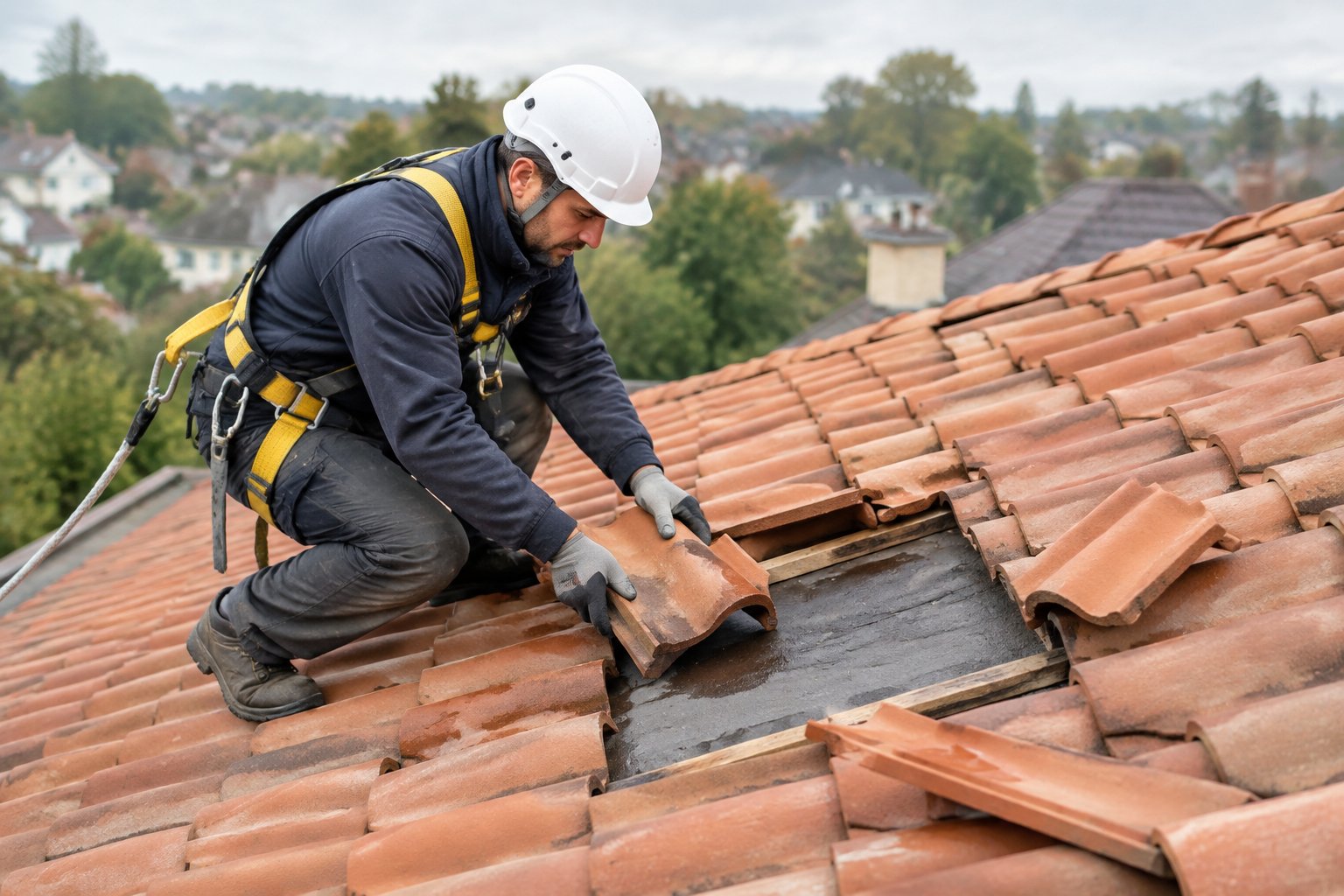
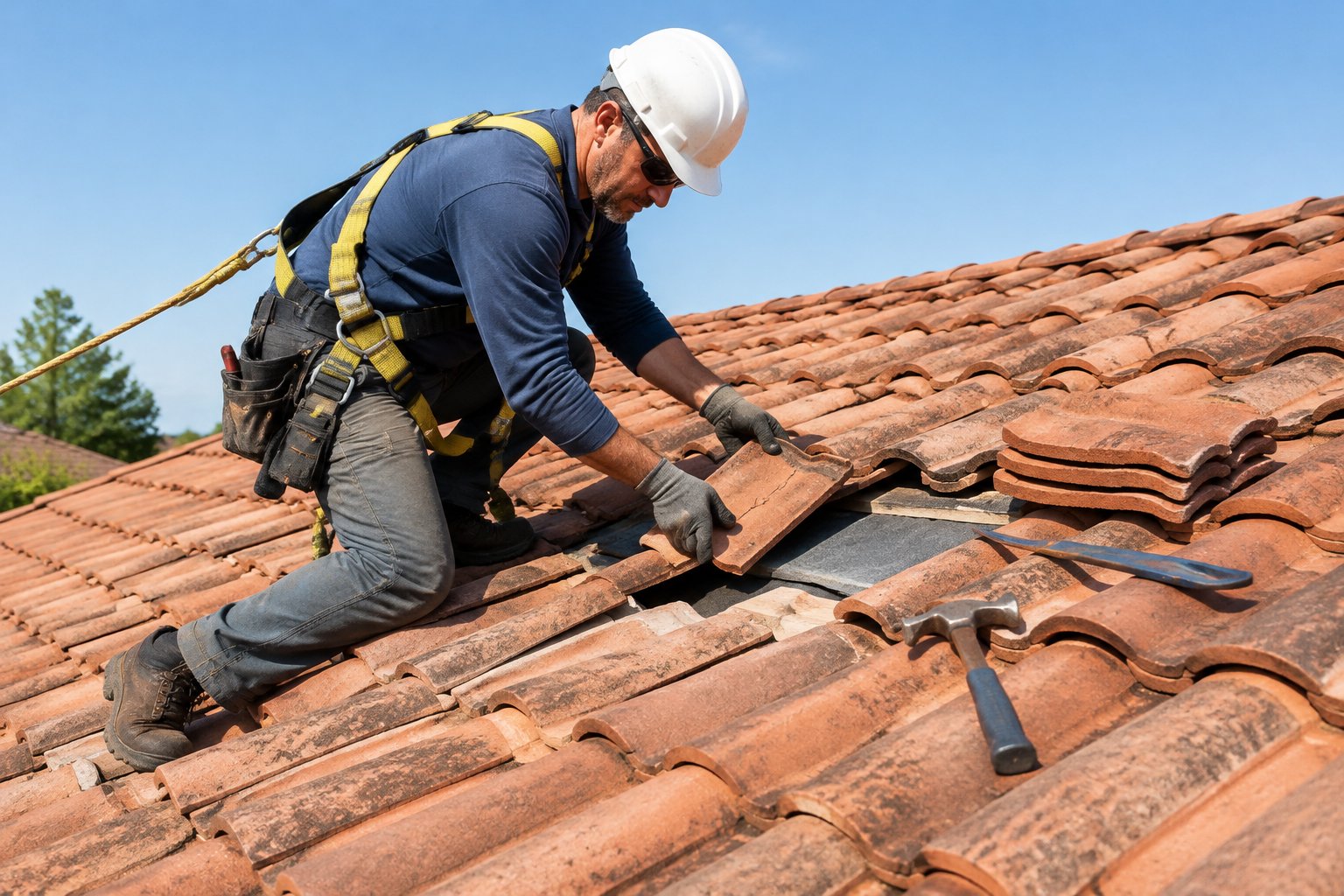
Lift the tiles above the broken one to free its head. On batten roofs, cut the nails or wire with a ripper or a thin bar. On mud-set roofs, work the mortar loose gently. Never pry against the tile next door.
Stack what comes off in order on padded boards near the work, and walk only on the lower third of each tile where the course below supports it. Even careful crews break some, which is why the replacements and the overage want to be on site before the roof opens.
Repair the layers underneath first
Replace rotten deck boards and split battens. Patch or lap in new underlayment shingle-style so water runs over each layer rather than into it. Swap corroded valley metal for copper or another long-life metal, because a clay roof can run a century and short-life flashing simply schedules the next leak.
Refix to suit the original system
On mud-set roofs, bed tiles in mortar of similar strength to the old bed. Hard, high-cement mortar cracks old clay as the roof moves. On batten-set roofs, refix with copper or stainless nails or wire, never galvanized, which corrodes and lets tiles slip. Where a salvaged tile has lost its nib, a tile hook or wire tie can hold it if that suits the roof.
Leave the roofing cement alone
Cement smeared over joints traps water and blocks the channels meant to drain it, and it hides failed flashing from whoever looks at the roof next. It is also close to impossible to get off old clay without breaking tiles, and on a historic building it reads as neglect. Emergency patch at most, then a proper repair soon after.
What drives the cost
On a period clay roof, whether matching tile can be found moves the number more than labor rates do. A good match keeps the repair invisible. A mismatch leaves a visible patch and pushes owners toward replacing a roof that did not need replacing.
Ask for a line-item bid separating tile count and freight from access and from labor. Steep pitch, height and complex shapes drive access cost hard, and a few broken tiles high on a turret can beat a dozen on a low porch. Add an allowance for concealed damage, because opening the roof regularly finds more failed underlayment than the leak suggested.
Scope follows the extent of the failure. Isolated breaks with sound underlayment around them are a local repair. Underlayment failing across one slope means lifting that tile, replacing the layers and relaying the same tile. Underlayment failing everywhere means the whole roof comes off and goes back onto new layers, with the original tile reused. Federal guidance for historic buildings puts repair ahead of replacement and reserves new material for where repair is genuinely not possible.
Get two written scopes from contractors who can show you past clay work, each naming the profile, the fixing method, the underlayment specification and the flashing metal, and each stating who supplies the tile. Treat any bid proposing full replacement without first checking whether the tile is sound with real suspicion. On a listed or district property, clear the scope with the review board before work starts.
Keeping it from happening again
Repeat failures come from foot traffic, blocked drainage, or a detail that was never fixed properly. Check the roof from the ground with binoculars and from a ladder at the eaves, once a year and after every major storm, looking for slipped tiles, cracked covers, open joints and debris in valleys. Every trip onto the roof risks new breaks, so send somebody up only when there is a repair to do.
Clear valleys and gutters by hand or with a soft brush. Never pressure wash clay: the jet strips the fired surface and drives water under the courses. Light lichen does no harm and suits an aged roof.
Watch the flashings for lifted edges and rust, the ridge and hip mortar for cracks, and the field for tiles creeping downslope, which usually means corroded fixings. After heavy rain, look in the attic. Damp decking, mold, or frost on the nails in winter points to a leak or to poor ventilation, and trapped moist air rots the deck and shortens the underlayment's life.
Then keep spares. Order extra from the matched batch, store them flat and dry off the ground, and label each stack with the profile, the roof area it matches and the order date. When the next tile breaks, that turns a search into an afternoon's work.
Get the match before the roof opens
Identify the profile and fixing method, measure and photograph tiles from several areas, confirm the matching tile and the overage are on site, and only then start removing courses. That sequence is what keeps a repair invisible.
Clay tile reached American roofs through Spanish influence in the southern, southwestern and western states, and a great many of those roofs still carry their original tile. We hold reclaimed clay roof tiles for exactly this work, including the profiles that suit Mediterranean and Spanish Revival buildings, and everything is hand-inspected, sounded and culled before it is crated.
We supply material and do not install it, so our advice about what your roof needs is not shaped by the size of the job it would create. Orders ship crated and palletized to jobsites nationwide, typically within 3 to 7 business days of confirmation, and stock and price depend on the batch. Send your measurements and photos, then call 225-954-8393 for current availability and a delivered price.
Frequently Asked Questions
Can a Spanish tile roof be repaired without replacing the whole roof?
Usually, yes. Most problems are local: a few broken tiles, a failed valley, worn underlayment on one slope. A spot repair or a partial relay with matched salvaged tile deals with that without touching the rest of the roof.
Can one-piece S-tiles replace two-piece barrel tiles?
No. The two systems lap and drain differently, so mixing them leaves gaps and open joints. Barrel tiles need barrel tiles of the same taper, length and camber.
Can a clay tile with a broken nib be reused?
On a mud-set roof, often yes, because the mortar bed holds it. On a batten-set roof it cannot hang on its own, though a hook or wire tie will sometimes secure it. Check the roof's original fixing method first.
Where do replacement tiles for a discontinued Spanish profile come from?
Salvage, in practice, since most pre-war profiles are no longer made. Send measurements, photographs of the face, both ends and the underside, and any maker's mark, and call 225-954-8393 to check for a match.
Why does a Spanish tile roof leak when the tiles look intact?
The tile sheds most of the water while the underlayment and flashing do the actual waterproofing. When those fail, water gets through regardless of how good the tile looks. Blocked valleys and cracked ridge mortar are the other usual suspects.
How long can a Spanish clay tile roof last with proper repairs?
Spanish clay commonly runs 75 to 100 years and often longer. Underlayment, flashing and fixings wear out sooner and get replaced on their own cycle. Relay the original tile over new layers, keep matched spares, and the roof carries on for generations.