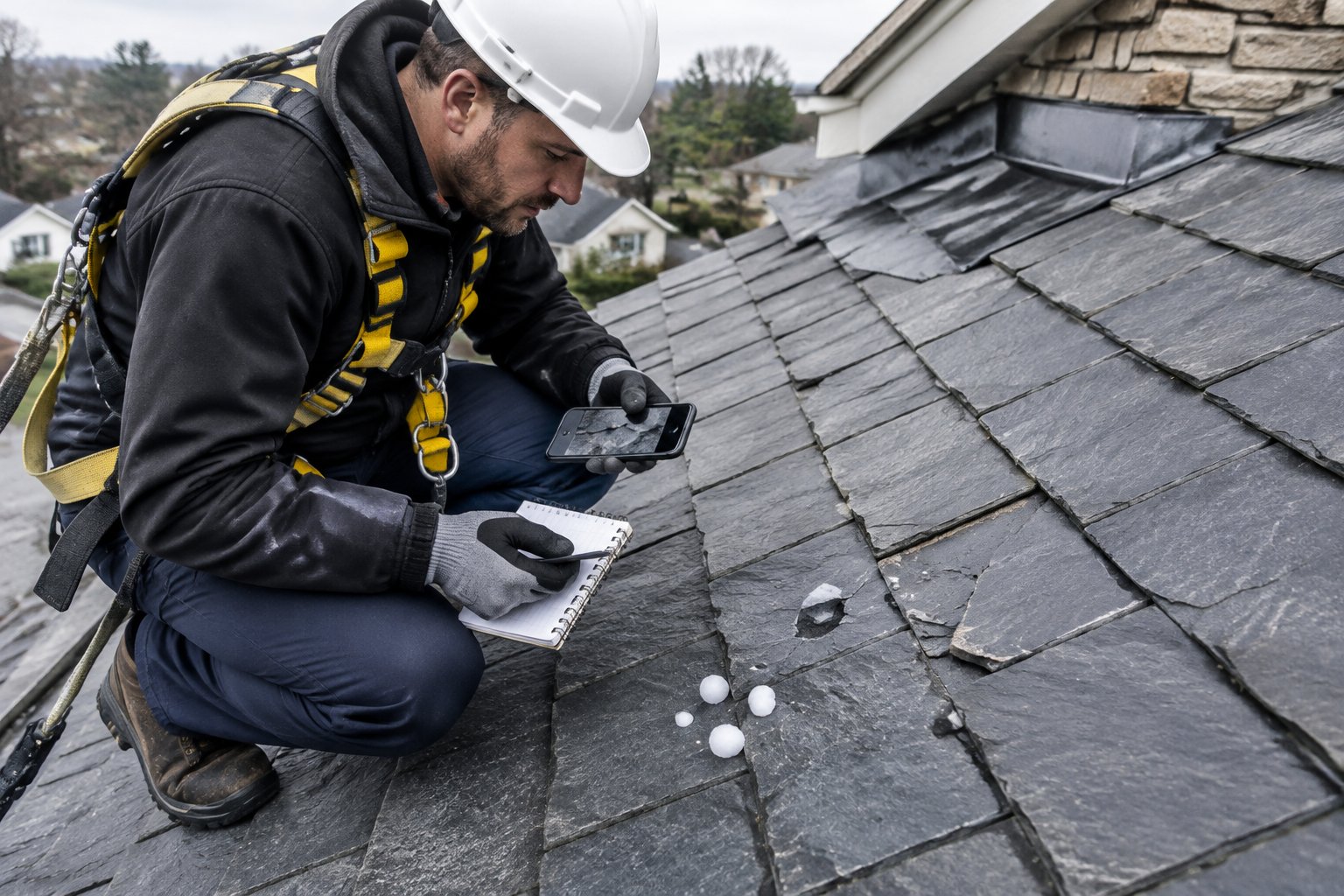
After a storm, the job is to separate hail damage from existing wear and write a repair scope that survives review.
Start from the physics. Hard, dense slate survives hailstorms that flatten asphalt. When hail does damage slate, it damages individual slates: cracked, punctured, broken at a corner. Those get replaced one at a time with matched material. Older roofs with soft or thin slate are more vulnerable, as are roofs where the fixings were already going.
The complication is usually the insurance side rather than the roof. Adjusters group pre-existing delamination, weathering and foot-traffic breaks in with storm damage, and some carriers push a full write-off when a few dozen matched slates would put the roof right.
What hail damage actually looks like on slate
A fresh fracture at the point of impact. Cracks, punctures, broken corners and edges, all with clean unweathered break faces. Slate does not dent and has no granules to lose, so the question is always whether the break is new and whether it stops the slate shedding water.
Breaks that matter
Slate roofs work on overlap, each course covering the nail line of the course below, with enough pitch to shed water, generally 4 inches of rise per 12 inches of run. A crack running up through the exposed face carries water past the headlap onto the underlayment. A puncture in the exposed field opens a direct path. A broken corner exposes the joint between the two slates below it.
Fresh breaks have sharp edges and a break face that is lighter or a different color from the weathered surface. You will usually find matching fragments in gutters or on the ground, with impacts clustered on the slopes that faced the storm, often with a radiating crack pattern centered on the strike.
Not every mark matters. A small surface spall on a slate that is still whole and still shedding water is cosmetic, and calling it functional damage undermines everything else in your report.
What it is not
- Delamination. The slate flakes in layers along its cleavage planes, edges soft or peeling. Many slates across a slope show the same thing with no directional pattern at all.
- Weathering. Surface softening, color drift and rounded edges over decades. The break faces look as weathered as the face.
- Foot traffic. Cracks running across the slate near the lower edge of the slate above, where somebody stood on the unsupported tail. Usually in lines along access routes, near chimneys and around old repairs.
- Fixing failure. Slipped slates with sound bodies and rusted nail stubs. That is corroded nails, not impact.
Hail damage has direction, fresh breaks and a link to a dated storm. Old damage has weathered break faces and turns up in places tied to age or traffic rather than wind.
What flashing and leaks do and do not prove
Dented copper or lead-coated copper helps establish that hail of a certain size hit the roof. Fresh dents in valley metal, gutters, downspouts and vent caps confirm storm size and direction. They do not prove any particular slate broke, because soft metal dents under impacts that hard slate shrugs off entirely.
Interior staining is weaker still. A new leak after a storm might come from a hail-broken slate, or failed underlayment, or corroded flashing, or a blocked valley that was always going to fail in heavy rain. Trace it to a specific slate or detail before you list it as storm-related.
Documenting it properly
Start the day of the storm and build a slate-by-slate map of what broke, where, and how you know it is new.
Record the event
Date, time, duration. Hail size if anybody saw it, and wind direction. Save weather reports and photographs of hailstones beside a ruler or a coin. The NOAA Storm Events Database records storms with enough intensity to cause significant property damage, which is useful for tying a loss to a confirmed event.
Survey without walking on it
Ground, ladder at the eaves, and attic first, with binoculars or a long lens. Keep owners and general crews off the slate entirely, because every untrained step creates a new break that an adjuster can fairly call non-storm damage. That single point costs more claims than anything else.
In the attic, look for daylight, wet sheathing and drips, and mark their positions against the roof above.
Map it by slope and course
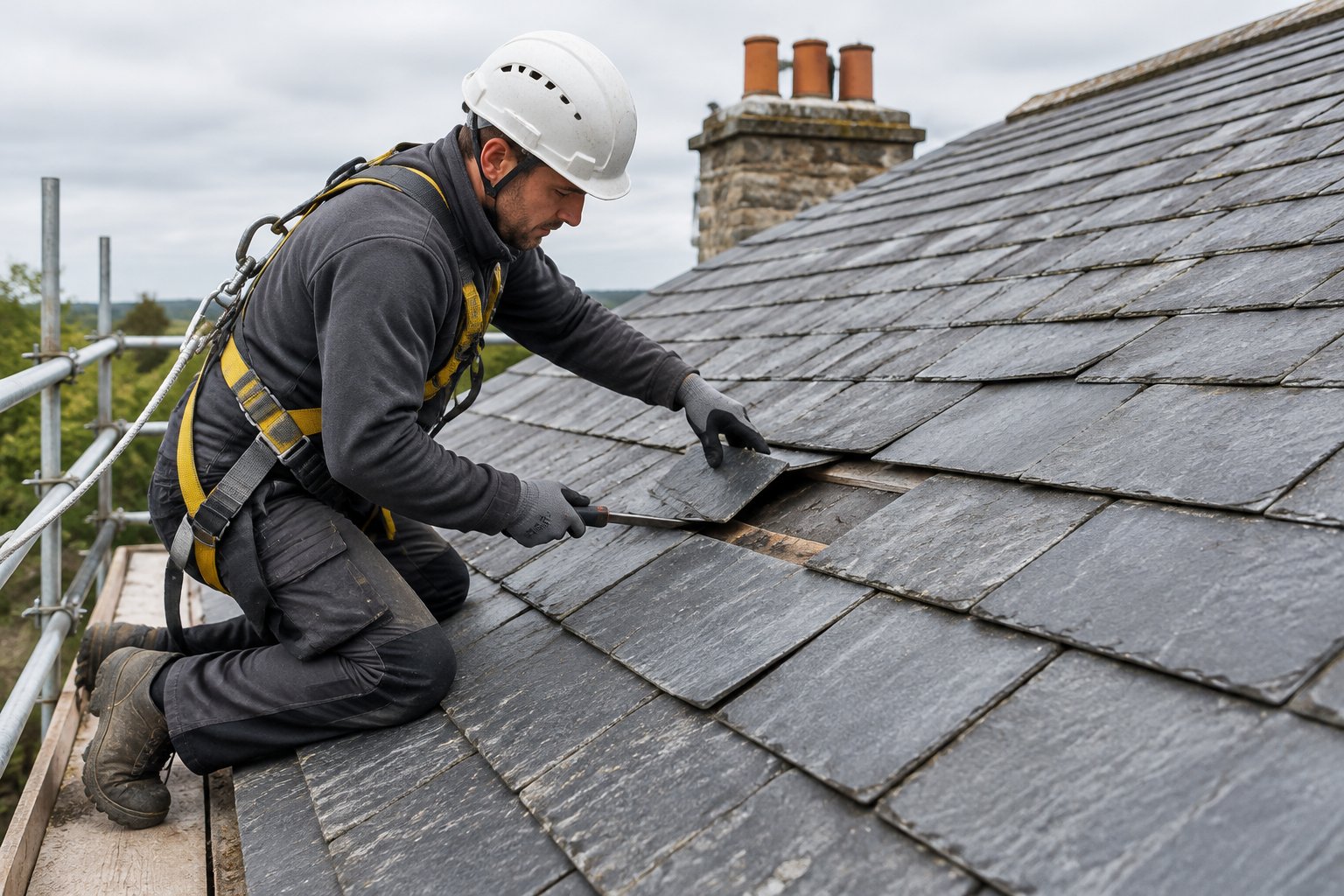
A slate contractor using roof ladders, hooks or staging rather than walking the field should record damage by slope, course and position, so each broken slate can be found again by a later reviewer. The map should also note how many slates on each slope show delamination or old breaks, which is what separates storm damage from existing condition.
They should sound a sample too. Sound slate rings, failing slate thuds, and that one test tells you whether the slate around the hail damage is worth keeping.
Photograph the old damage as well
Three shots per damaged slate: wide showing its place on the slope, mid-range, and a close-up of the break face with a scale. Number them to match the map.
Then photograph the existing conditions: delaminated areas, old repairs, slipped slates, labeled as pre-existing. This feels like weakening your own claim and does the exact opposite. A report that openly accounts for old wear makes the storm findings far more credible, and adjusters notice when one does not.
When matched slate restores the roof
When the slates around the damage are sound and the fixings hold, which covers most hail-damaged slate roofs. The National Park Service says historic slate roofs should be repaired rather than replaced whenever possible, and the logic holds for any well-built slate roof.
Let the map choose the scope
- Individual repairs. Scattered breaks on a sound roof. The most common outcome after hail.
- Section work. Heavy damage on one storm-facing slope, or a slope where fixing failure already required a strip and relay.
- Full replacement. Widespread soft or delaminating slate, or failed fixings across the whole roof. That is a condition problem, and it is not what the hail did.
Forty broken slates is an order for forty slates. Count the damage, then scope the work to the count.
Match fit before color
Measure length, width and thickness on several slates from the damaged slopes and work the exposure out from the courses. Replacements have to sit flat in the existing coursing, because one that is too thick lifts the course above and one that is too thin rattles and breaks.
Then match color to the weathered face rather than a broken edge, comparing in overcast light against several areas of the roof. Weathered Pennsylvania slate looks nothing like a fresh quarry run of the same stone. If you would rather not do that by eye, send us a slate and our matching service will work from the physical piece.
Check the batch before you commit
Ask for batch photographs with a tape in frame and confirm thickness range and size before approving anything. Reclaimed slate should be sounded and culled before it ships, and knowing how to evaluate reclaimed slate quality stops you buying slate that fails before the roof around it does.
Our orders are final sale, so approve against your own measurements, and order the breakage overage with the main batch rather than afterwards.
Fix them properly
Ripper out the broken slates, then secure replacements with copper or stainless hooks, or a copper nail with a bib flashing over the hole. Sealant smeared across a crack fails within a few seasons, traps water, and makes the roof look neglected, which is precisely the impression you do not want an insurer or a review board forming.
Need to confirm a match exists before you submit a scope? Call 225-954-8393 with the dimensions and photographs and we will tell you the same day.
Supporting a repair-based claim
Three things: the storm caused functional damage, the damage can be counted slate by slate, and matching material is available. Each one answers a specific reason carriers deny claims or demand more work than the roof needs.
Functional, cosmetic and excluded
Most policies cover sudden physical loss and exclude wear, deterioration and poor maintenance. Functional damage means the slate can no longer shed water or will now fail early: through-cracks, punctures, lost corners. Surface marks on an intact slate may be cosmetic, which some policies exclude outright. Delamination is wear.
Keep those three categories separate in the report so they cannot be blurred together, in either direction.
Itemise, and prove the match
List each damaged slate by slope and position. Include matching specifications for size, thickness, color and type, the fixing method, and labor per slope. Attach batch photographs and written confirmation that matching slate is available.
That last document answers the most common carrier objection there is, which is that no match exists so the whole roof has to go. Having it in writing before the conversation starts changes the conversation.
Challenge an unjustified write-off
Full replacement is attractive to a carrier because it is quick to price and closes the file. For an owner of a sound slate roof it destroys something that had decades left. The NPS puts slate roof life at 60 to 125 years and some run past 200.
Where the map shows scattered damage on sound slate, ask the carrier in writing to explain why repair is not feasible. And be alert if a write-off arrives bundled with an offer of synthetic or composite slate, because those products cannot match the existing field, age differently, and do not meet replacement-in-kind standards on historic or high-end work.
Price the whole job
- Roof ladders, hooks or scaffold for steep or tall slopes
- Sourcing and matching time
- Freight, crated and palletized, with liftgate if the site needs it
- Breakage allowance during repair
- Concealed damage found once slates come off, such as wet sheathing or broken slates underneath
Add a supplement clause for concealed damage so the scope can expand once the roof is open without renegotiating from scratch.
If the scope is disputed
Where the adjuster has no slate experience, ask for a reinspection with a slate contractor present and bring the map, the sounding results and the matching documentation. If it stalls, a public adjuster can represent the owner for a share of the settlement, which makes sense on large losses or firm denials. Many policies also carry an appraisal clause for disputes over scope or amount.
What impact testing does and does not establish
Roofing slate has been tested under FM 4473, which fires ice balls at installed samples and assigns ratings from Class 1 to Class 4, larger ice balls for higher classes. The results line up with what roofers see: hard natural slate performs well, thicker slates reach the higher classes, thinner slates rate lower.
What that does not do is certify any individual roof or batch. Test samples are new, sound slate of known type and thickness, whereas reclaimed batches vary by quarry, age and how they weathered on the first roof. Good slate's low water absorption, less than 0.4%, is what helps it hold strength over time, and softer slates lose strength faster. Judge each batch on its own sound and thickness rather than borrowing a test class from elsewhere.
What underlayment and maintenance can do
Impact-resistant underlayment does not make slate harder. It limits leaks in the window between a slate breaking and being replaced. Where a crew strips and relays a slope after a storm, specify underlayment rated for a long-life roof with self-adhered membrane at eaves and valleys. Our specification support can help you pick something that suits the slate and the climate.
Maintenance matters between storms. Replace cracked slates promptly, keep valleys and gutters clear, and check flashing after every major hail event. A current maintenance record also leaves an adjuster far less room to attribute storm losses to neglect.
Count it, match it, document it
A hail-hit slate roof usually needs a count and a match, not a replacement. Separate fresh impact from delamination, weathering and foot traffic. Map every broken slate by slope and course, and photograph the old conditions alongside the new damage.
Build the claim on functional damage, an itemised scope, and proof that matching slate exists. Price access, freight, breakage and concealed damage up front. Where a carrier calls for replacement while the slate still rings sound, push back in writing, and where matching is the sticking point, NPS guidance that replacement in kind to match the existing is the preferred treatment is worth quoting directly.
We supply matched reclaimed slate for this work and do not perform repairs or inspections, so our reading of a roof is not shaped by the size of the job it creates. Everything is sounded and culled by hand, and orders typically ship in 3 to 7 business days. Call 225-954-8393 with your measurements and photos for current availability and a delivered price.
Frequently Asked Questions
Are slate roofs good against hail?
Yes. Hard dense natural slate resists most hail that damages asphalt and composite roofing. Thin, soft or heavily weathered slate is more vulnerable, so age and slate type affect the outcome.
Can photographs alone confirm hail damage?
No. They support a claim, but somebody has to examine break faces, sound the slates and tie the damage to a dated storm. Photographs linked to a slope-by-slope map carry far more weight than a folder of loose images.
What does it cost to repair hail-damaged slate?
It depends on how many slates broke, the pitch and height, the staging needed and the price of matching slate. Material prices vary by batch, so call 225-954-8393 for a delivered figure.
Does homeowners insurance cover hail damage to slate?
Most policies cover sudden hail damage and exclude wear and deterioration, and some limit or exclude cosmetic damage. Read the policy and document functional damage separately from existing conditions.
Does an older slate roof need replacing after hail?
Not automatically. Age alone condemns nothing. If the slates still ring sound and the fixings hold, repairing the broken pieces restores the roof.
Can reclaimed slate match a discontinued slate?
Frequently, yes. Salvaged slate from the same quarry region and era can match size, thickness and weathered color even where new production has stopped entirely.