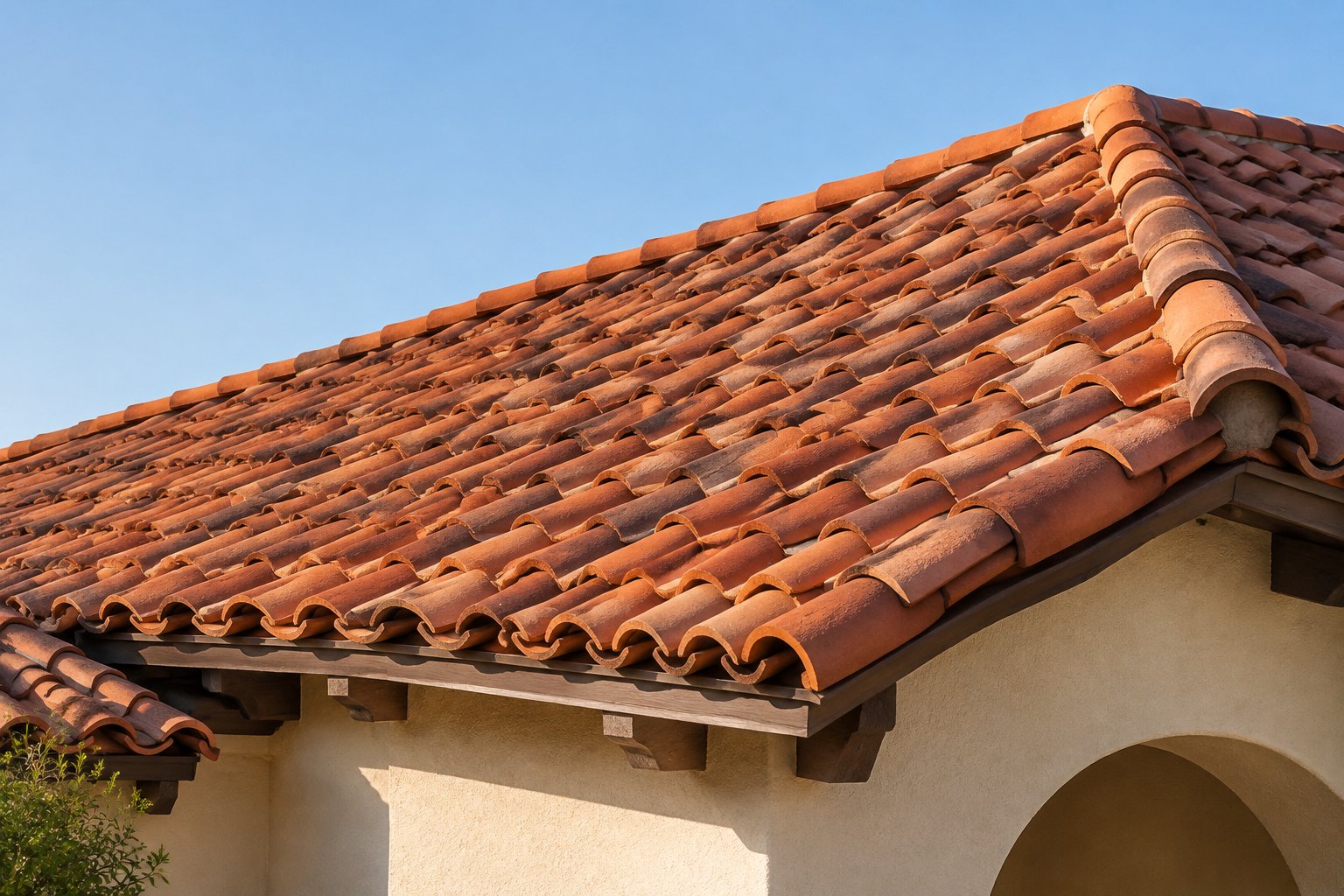
There is a stain on the ceiling, a schedule to keep, and an owner who does not want a patchwork roof at the end of it.
Start from this: on a tile roof the leak is almost never the tile. It is the underlayment, the flashing or the drainage underneath. Clay tile lasts 75 to 100 years and more. The felt, metal and mortar beneath it give out decades sooner, and that gap shapes every decision on the job.
Which means a repair that lasts involves lifting sound tiles, fixing the failed layer, and relaying the original tile with matched spares already on site. Not sealing something from above and hoping.
Where water actually gets in
Clay and concrete both shed most water, and both have gaps by design. Wind-driven rain, snowmelt and backed-up runoff all reach the layer below, which is exactly what that layer is there for. You get a leak when it stops doing its job.
Work through the causes in order of likelihood rather than starting with the tile.
Failed underlayment under perfectly good tile
This is the most common cause by a distance. Felt under tile gives 20 to 30 years on most roofs. It dries out, cracks along the batten lines and tears where old nails pass through, while the tiles above look immaculate.
From the attic, look for dark soft spots on the deck and daylight through sheathing joints. Rot running in a straight line along the batten lines tells you it is the felt, not one bad tile. That pattern is worth learning, because it saves a lot of pointless tile hunting.
Valleys, step flashing and chimneys
Valleys carry more water than anything else on the roof. Valley metal that has rusted through, split at a seam or been cut too narrow lets water run under the tile edges, and old galvanized valleys rust from the center out, right where the flow is heaviest.
Step flashing at walls is next. Each piece has to overlap the one below so water runs over it, extending at least 4 inches up the wall and 4 inches onto the deck, lapped shingle fashion with the wall barrier. Short or reversed laps send water behind the siding and into the framing, where it does real damage before anyone notices.
Chimneys combine both problems. Counterflashing pulls out of mortar joints, back pans fill with debris, and cricket metal on wide stacks either rusts or was never fitted in the first place.
Penetrations and ridge mortar
Vents, pipes, skylights and solar mounts all cut through tile and felt, and the boots and lead flashings around them crack with age. Anything added later is worth a close look, because retrofitted vents are often set without lapping the felt properly, so water runs straight down the pipe into the attic.
Ridge and hip mortar is the other regular offender. It shrinks, cracks and drops out, leaving gaps under the cap tiles that wind-driven rain goes straight into. Stains near the peak usually trace back here.
Blocked valleys and broken tiles
A blocked valley leaks even with sound metal. Leaves, needles and broken tile build a dam, water backs up over the valley edge and runs sideways under the field tile. It shows up after heavy storms and catches people out because the metal itself is fine.
A cracked or slipped tile causes leaks far less often than owners assume. One crack lets in very little, and sound felt handles it without complaint. When a broken tile does produce a leak, the felt underneath has almost always failed already. Fix both or it comes back.
Tracing a leak on a batten system
Follow the water backwards, from the stain up through the framing to wherever it first got past the tile. Battens and counter-battens behave like small gutters, so water can travel several feet before it drips. The ceiling stain shows you where it landed, which is rarely where it came in.
Start with a full inspection inside and out. The National Park Service recommends a complete internal and external inspection to find the source before planning any clay tile repair.
Map the inside first
Get into the attic during or just after rain. Mark every wet spot, drip line and stain on the rafters and deck, photograph each with a tape in frame, and note old stains as well, because they show you previous water paths.
Then work uphill. Water leaves tide marks on timber and runs along the underside of battens and the faces of rafters. A moisture meter and a bright light will get you there. The highest wet point on the path is close to the entry.
Look upslope, not just above the stain
Once you have the highest wet point, check everything above it in the same rafter bay: valleys, flashings, vents, ridge. A stain in the middle of a slope can easily originate from flashing ten feet higher.
Inspect from a ladder at the eave and use proper walk boards on the roof, since every step on clay risks a crack. Before lifting anything, look for gaps, debris dams, rusted metal and missing mortar. Plenty of leaks are visible from outside if you know what you are looking at.
Water testing, from the bottom up
When the source is still unclear, test it. Garden hose at low pressure, starting at the lowest suspect detail, wetting only that area for ten to fifteen minutes while someone watches from the attic with a light.
Move upslope one detail at a time. Never start at the top, because water then flows over every lower detail and tells you nothing. When the drip appears, you have your entry point.
Rule out condensation
Not all water damage is a leak. Warm moist house air meeting a cold deck drips, and the signs are different: frost or wet spots spread across the whole deck rather than a single path, usually on the north side, in cold weather, and often with no rain at all.
Poor attic ventilation and blocked soffits make it worse, and tight decks under concrete tile are particularly prone. If the wet pattern does not line up with a rain event or a flashing detail, check bath fans, venting and air sealing before you open the roof.
What a lasting repair involves
Opening the roof, fixing the failed layer, and putting the same tiles back. There is no way to repair felt, flashing or decking from the tile surface, whatever anyone tells you.
Lifting tile without destroying it
Set access up before you touch anything. Roof ladders, walk boards or foam pads, stepping on the lower third of each tile where the course below supports it. Avoid working cold clay, which is at its most brittle.
Lift from the top of the work area downwards, cutting or pulling fixings carefully. Chalk-mark the tiles if you want to preserve color position in the field. Stack them on edge on padded boards close to the work, never loose on the slope where one knock takes out a dozen.
Expect breakage regardless. Old nail holes crack, nibs snap, and tiles that were already cracked come apart in your hands. On salvaged clay a lift and relay typically costs you 10 to 15 percent, more on brittle or previously patched roofs.
Deck, battens and laps
With the tile off, assess the deck. Replace soft or rotted sheathing, and swap split battens for treated stock at the same height, because a batten a quarter inch out throws off every course above it.
Lay new underlayment with the laps running the right way: every upper sheet over the lower one so water is always delivered onto the next layer down. Tie into the existing felt beyond the repair with a generous lap, slipping the new material under the old upslope layer and never over it. Get that backwards and you have built a funnel.
Replace failed metal rather than coating it
Roofing cement over a rusted valley is a delay, not a repair. In valleys, a self-adhered membrane under the felt gives you a genuine second line of defense, laid low point to high with sections lapped 6 inches shingle fashion, centered and free of folds.
Use copper or heavy-gauge metal for new valleys and step flashing. Cut new counterflashing into the chimney mortar joints properly, rebuild crickets where they are missing, and clear debris out of valley openings that are trapping leaves at the tile edges.
Reset and verify
Relay the original tiles where you marked them, with copper or stainless fixings. Check each one sits flat and engages its neighbors. Rebed hips and ridges with a mix softer than the tile.
Then run the same hose test you used to find the leak, watch the attic, and check again after the next real storm. A repair nobody verified is a repair nobody can stand behind.
What sealant can and cannot do
Sealant buys time. It does not fix failed underlayment or a rusted valley. Worse, caulk on a tile face traps water and glues tiles together, so the next person to lift them breaks them.
Use it to hold a situation until the roof can be opened properly, and tell the owner that is what you are doing.
Need matched tile on site before you open a roof? Call 225-954-8393 and we will tell you what we have and how fast it can get to you.
Why the spares have to arrive first
Breakage is certain and an open roof cannot wait for a search. Run short mid-job and you are tarping a hole and losing days, or filling gaps with a near-match that will be visible for the rest of the roof's life.
Older profiles are frequently out of production, so on a pre-war clay roof salvage is often the only route to a repair that disappears.
Document before you order
Measure the real tile: length, width, thickness at the nose. Measure camber by laying it on a flat board. Note exposure and headlap as laid on the roof.
Photograph the underside and look for maker's marks, and record the fixing method, whether nail holes, wire holes or clips. A tile that matches on size but has its holes in the wrong place will not suit your batten spacing. Our guide to matching old roof tiles covers this by profile and maker.
Fit first, color second
Clay color runs through the body and does not fade, but weathering, lichen and soot change the face over decades. Photograph in overcast light and sample several slopes, since sun and shade age tiles differently.
Then put fit ahead of color. A tile with the right color and the wrong camber rocks, cracks and leaks. Choose the closest fit, then the closest color, and welcome variation within the batch because period roofs read as a blend.
Check nibs, lugs and interlocks
Broken nibs and lugs are the main reason a salvaged tile cannot be reused, so check every replacement. A missing nib means it cannot hang on the batten. A chipped interlock lets water past the side lap.
Interlocking profiles need particular care, because side and head locks have to engage with the tile already on the roof. Check salvaged interlocking clay tiles against a sample from your own roof before you open anything.
One batch, with overage
Order from a single batch where you can, so color and size line up, and ask for batch photographs. Set overage against the job: a local repair needs fewer spares than a full relay, but you will always need more than the number of broken tiles you can actually see.
Our reclaimed clay roof tiles are sounded and culled before they leave the yard, which means fewer duds in the crate and a more honest count. Orders are final sale, so we send photographs and let you confirm the match before anything moves.
Scope and cost
Access, the depth of the failure and the availability of matching tile. Lifting and relaying a few tiles is modest work. Staging a steep three-story roof is not, and a rare tile with no match can turn a small repair into a much larger job.
Local repair or wider relay
A local repair suits one failed detail on a roof with sound felt everywhere else: a chimney flashing, a single valley. Lift the tiles around it, fix the detail, relay them.
A wider relay is the answer when felt has failed across a slope, because patching one spot there usually just moves the leak next door. If the attic shows rot along several batten lines, plan to replace felt across the full slope with the same tiles going back down.
Do not let failed felt condemn good tile
Replacement quotes routinely bundle the two together even when the tile has another fifty years in it. Write down which components have failed and which are sound, and insist the quote reflects that distinction.
On historic roofs, federal standards favor retaining and preserving roofing material such as clay tile that defines a building's character, which is a useful thing to have in writing when somebody is pushing a tear-off.
Check it again later
Inspect after the first heavy storm, then annually. Look for debris in valleys and new staining in the attic, and keep gutters clear so water is not backing up at the eave.
If the same spot keeps leaking, the problem is probably drainage rather than the repair. Trees over a valley will keep filling it. A cricket that is too small will keep flooding behind the chimney. Those need fixing at the cause.
Fix what failed, keep what has not
Trace the water uphill along battens and rafters, testing one detail at a time. Open the roof, repair the felt, flashing or deck, relay the original tile. Plan for breakage before work starts, measure the profile and camber, check nibs and interlocks, and have matched spares waiting.
On historic roof restoration, putting the original tile back is what owners and review boards expect, and it is usually the cheaper answer as well.
We supply matched salvaged tile and do not carry out roofing work, so we have no interest in talking you into a bigger job. Orders ship crated and palletized with liftgate and scheduled delivery available, which matters when a roof is open. Call 225-954-8393 for current availability and a delivered price.
Frequently Asked Questions
Can a leaking tile roof be fixed from inside the attic?
No. Use the attic to trace the leak and check for rot, but the failed felt or flashing sits under the tiles and has to be reached from above. Patches applied from inside trap water in the deck and make things worse.
Why does my roof only leak in heavy rain?
Heavy rain tests the weak details. Valleys back up, water rises over flashing edges, and wind pushes rain under tiles and into ridge gaps. Light rain drains past all of that without ever reaching the deck.
Will the roof leak if one tile is missing?
Sometimes, depending on the felt below. Sound underlayment holds water off for a while, but sun and weather degrade it quickly once exposed. Replace the tile soon and check the felt while the roof is open.
What is the best sealant for a leaking tile roof?
There is not one that fixes it permanently. Sealants stop a drip briefly, but failed felt or flashing under the tile is nearly always the real cause. Use it to buy time, not as the repair.
Can underlayment be repaired without replacing all the tiles?
Yes, locally. Lift the tiles over the failed section, lap new underlayment correctly into the old, relay the same tiles. If the felt has gone across the whole slope, plan a full relay of that slope instead.
Does insurance cover water damage from a leaking tile roof?
It depends on the policy and the cause. A storm-broken tile is usually treated differently from slow wear on aged felt. Photograph the stains, the attic and the roof as early as you can, then ask your agent how each type of damage is handled.