A Peach Bottom roof, a few dozen broken or missing slates, and an owner or review board expecting the repair to disappear. You need to know what you are looking at, how much life the slate has left, and where a match comes from.
Peach Bottom is a hard, dense, blue-black slate from the Pennsylvania–Maryland line. The quarries closed decades ago, so reclaimed slate is the only source of genuine replacements. Where no Peach Bottom is available, another unfading black can come close, and it is worth being straight with everyone about the difference.
Why this slate lasts
Because it is hard, dense and absorbs almost nothing. Those three work together: dense slate resists frost, holds its nail holes and keeps its edges sharp for generations.
What density does on a roof
Slate as a group carries a water absorption index below 0.4%, which is what gets it through freeze-thaw, and Peach Bottom sits at the hard end of that range. In practice that means fewer flaking faces, fewer soft edges, and fewer breaks when a slate gets lifted for a repair.
Hardness also changes how it behaves under a slate hammer. Hard slate punches cleanly and trims to a sharp break, where soft slate crumbles at the hole. Re-punching salvaged Peach Bottom gives you a clean hole, with one caution: dense slate cracks if the hole goes too close to the edge.
Carbon in the rock gives it the dark color, from carbonaceous matter laid down on ancient sea floors, and it holds that color for the life of the roof. Peach Bottom is an unfading slate.
How long it runs
Properly installed slate roofs last 60 to 125 years or longer, and some slates have passed 200. Peach Bottom sits at the top of that scale, and plenty of roofs from the 1800s are still shedding water on their original stone.
That life depends on more than the slate, though. Pitch, climate and the quality of the original construction all play into it, which is why two roofs of the same stone can be in very different condition at the same age.
Sound slate outlasting its fixings
On an old Peach Bottom roof the slate is rarely what fails first. Iron nails rust through, flashings wear out at valleys and chimneys, battens and decking rot. Slates slip, leaks start, and the roof looks finished while most of the stone is still perfectly good.
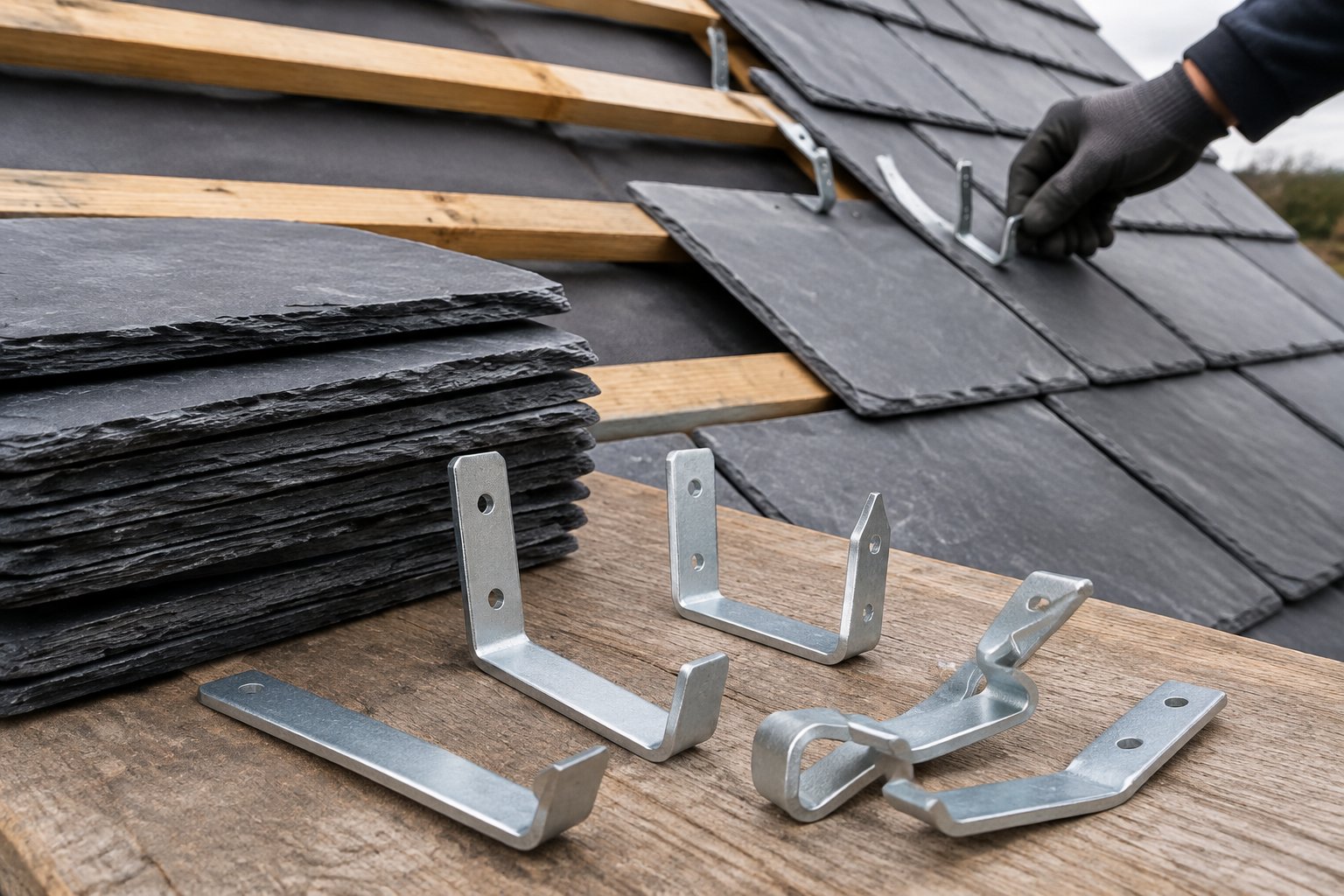
Which is why repair is the right first move. The National Park Service holds that historic slate roofs should be repaired rather than replaced whenever possible. Given how long the stone lasts, use copper or stainless fixings and copper or lead-coated copper flashings so the next repair cycle is decades out rather than years.
Before any strip-and-relay, sound every slate. A clear ring means it goes back up. A dull thud means a crack or hidden delamination. Then buy matched reclaimed slate only to cover the breakage and the culls, which on hard stone like this is a smaller number than most people expect.
Identifying an existing roof
By combining what the slate looks like with where and when the building was built. No single clue settles it, but color, density, the broken edge and the building's history together make a solid case.
Color, grain and density
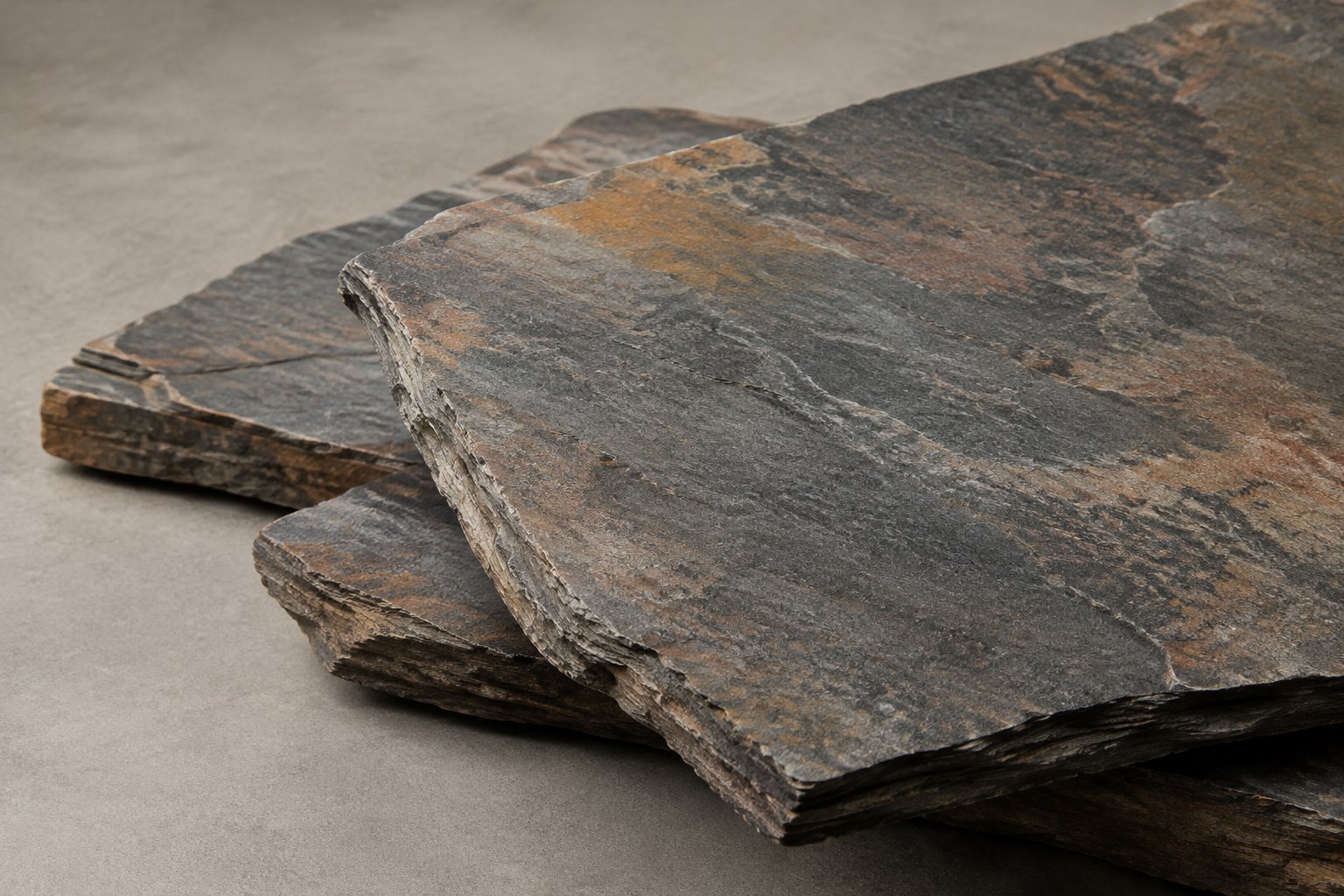
Peach Bottom reads as a deep blue-black. In bright sun it can show a faint blue cast; under overcast skies it is close to pure black. The surface is smooth with a fine grain and a slight sheen, and many pieces carry a soft silky luster that gets compared to graphite.
Pick one up. It feels heavy for its size. Tap it with a knuckle or the back of a hammer and listen for a sharp ring. Old roofs often carry fairly thin, even pieces, which is a sign of slate that split well along its cleavage.
Other black slates look similar from the ground. Buckingham from Virginia and some Pennsylvania blacks share the tone, so compare side by side in the same light before you put a name to it.
The weathered face and a broken edge
They tell you different things, so look at both. An old Peach Bottom slate stays dark on its exposed face, often with a dull or slightly chalky film from a century of weather, and the surface holds together without heavy flaking.
Then snap a scrap or inspect a fresh chip. Peach Bottom breaks dark, dense and fine-grained with a clean edge and no crumbling. Soft slates show grainy flaky breaks or lighter cores, and a rusty or brown break, or one layered like old paper, points at softer slate or slate that is failing.
Do not match on a cleaned or freshly broken face. The roof is seen by its weathered faces, so match those and use the break only to confirm density.
Dates, location and records
Location and date narrow it quickly. Builders used Peach Bottom heavily across the Mid-Atlantic, particularly southern Pennsylvania, Maryland, Delaware and around Baltimore and Philadelphia, and a mid-1800s to early-1900s building in that region is a strong candidate.
Then check the paperwork. Building permits, original specifications, church and school archives and old contractor invoices sometimes name the slate outright. Local historical societies and state preservation offices hold notes on major buildings. A roof on a farm or barn near the quarry belt is very often local slate, because builders in slate country used what was at hand.
Where records are missing, treat the identification as a strong likelihood rather than a certainty. Photograph faces and edges, measure several slates, record the building date, and keep that file, because it is what your supplier and any review board will work from.
Have a Peach Bottom roof to match? Send face and edge photographs with your measurements and call 225-954-8393 for current stock.
Sourcing a match now production has ended
From salvage, then checked against your roof before anything ships.
Why genuine replacements can only be reclaimed
The only true Peach Bottom left is on existing roofs. When buildings in the region come down, the slate can be stripped, sorted and resold, and that is the whole supply.
Preservation guidance points the same way: replacement in kind to match the existing roof is always the preferred treatment for damaged or missing historic slate, and federal rehab standards flag stripping a roof of sound historic material such as slate as a practice to avoid.
Synthetic and composite products do not belong on this kind of roof. They read flat beside century-old stone, they can fade, and they frequently fail review. Genuine salvaged slate keeps the repair in character and keeps the building eligible, which matters on any project working toward tax credits or district approval.
Comparing samples against the batch
Every reclaimed batch is different, so compare before committing. Send clear photographs of the roof in overcast light from more than one area, with a tape across the length and width of a few slates and a shot of the edge for thickness.
Then check the batch on:
- Color, weathered face against weathered face, in the same light
- Thickness, close enough to the existing slate that courses lie flat
- Length and width, matched to your exposure and headlap
- Nail holes, clean, with enough sound stone around them to re-punch if needed
- Condition, rings when sounded, no delamination, no soft edges
We send batch photographs before any order is confirmed, and our slate matching review against your own photographs and measurements catches problems before anybody books freight. Our notes on how to evaluate reclaimed slate quality cover grading in more depth.
When Buckingham is the honest fallback
Where no Peach Bottom exists, Buckingham is the strongest substitute. Quarried in Virginia, it is dense, hard, unfading black with a fine grain and a similar sheen, and its durability is close enough that it performs much the same on a roof.
Say plainly that it is a near-match. Buckingham can show a slightly different blue-gray cast, and fresh stock reads crisper than weathered Peach Bottom. Reclaimed Buckingham black slate closes most of that gap, because its face has already weathered.
Placement does the rest. Put the near-match on a rear slope, a dormer or an out-of-sight plane, and move the original Peach Bottom from there onto the front elevation, which keeps the main view uniform. Other reclaimed black slate works the same way on small patches.
Quantities and freight
Confirm the full count before ordering, because a second batch may not match the first. Measure the area to cover including starter course, hips and ridge, then add overage, and allow more than you would on new slate for breakage and culls. Peach Bottom batches are limited, so buy enough the first time.
Price and stock both follow the batch, and since demolitions determine when Peach Bottom appears at all, no fixed price holds for long. Orders ship crated and palletized with liftgate service and scheduling on request, and tracking goes out before shipment. Inspect crates on arrival and report freight damage within 48 hours, and approve the batch photographs properly, since sales are final. Where nothing is on hand, our custom sourcing works the salvage network for your size and count.
Where it came from
A narrow slate ridge straddling the Mason-Dixon Line between York County, Pennsylvania and Harford County, Maryland. Its reputation went from local roofs to the national market in under a century.
Delta, Cardiff and Whiteford
The quarries ran along a thin belt of slate near the Susquehanna River, and the towns of Delta in Pennsylvania and Cardiff and Whiteford in Maryland grew up around them. Pits, waste piles and slate-built houses still mark the area.
This is where American slate quarrying started. William Docher ran the first commercial slate quarry in the United States, which opened in 1785 in Peach Bottom Township, Pennsylvania. For decades its output served nearby markets only, because moving heavy stone overland was slow and expensive.
Local builders used it for houses, barns, churches, fences and sidewalks, which is why so many farm buildings in the region still carry slate roofs today.
Welsh quarrymen and the canal
Welsh immigrants brought the skills that grew the industry. Many arrived from the slate districts of North Wales in the mid-1800s and settled around Delta and Cardiff, and Cardiff takes its name from the Welsh city. Their quarrying and splitting raised both the output and the quality of the finished roofing slate.
Transport did the rest. The Susquehanna and Tidewater Canal ran along the river and gave the quarries a route to Baltimore and the Chesapeake, and the railroads later opened more. Slate from the belt reached cities across the Mid-Atlantic and beyond.
It was never the largest producer. The bigger districts in Lehigh and Northampton Counties and in Vermont outproduced it comfortably. Peach Bottom held its place on quality instead.
The 1851 Great Exhibition
Its reputation took a significant step at the Great Exhibition in London, held at the Crystal Palace, where judges ranked slate from the region among the best roofing slates in the world. Builders and architects used that recognition as a selling point for decades afterward.
The roofs justified it. Peach Bottom roofs from the 1800s still cover churches, courthouses and homes across the region, and their owners have every reason to keep the original stone where it is.
Production faded through the 20th century as the slate industry contracted and cheaper roofing took the market. The quarries sit idle now and the remaining supply comes off roofs, which means period-correct matching on these buildings depends entirely on salvage.
Verify the match, keep the roof
Peach Bottom is hard, dense, unfading and long-lived, and the slate on your roof probably has decades left in it. Most failures come from rusted nails, worn flashings or rotted decking. Replace those in copper or stainless, keep the sound slate, and replace only what is broken.
Confirm what you have before you buy: color in overcast light, a fresh break for density, and the building's date and location against the Mid-Atlantic quarry belt. Then compare reclaimed batches on color, thickness, size and condition, and approve photographs before anything ships. Where Peach Bottom runs short, use reclaimed Buckingham on the hidden slopes and tell the owner exactly what it is.
We hold Peach Bottom and other reclaimed blacks as they come through the yard, hand-inspected, sounded and culled before crating, builder-direct with no retail markup, shipping typically 3 to 7 business days after confirmation. We supply material and do not install it. Call 225-954-8393 for current Peach Bottom and black slate availability and a delivered price to your jobsite.
Frequently Asked Questions
Is Peach Bottom slate still quarried?
No. The quarries along the Pennsylvania–Maryland line closed decades ago, so genuine Peach Bottom now comes off older buildings.
Where can I buy reclaimed Peach Bottom slate?
From salvage suppliers who ship nationwide, so your location matters far less than what is currently in stock. Supply follows recent Mid-Atlantic demolitions. Call 225-954-8393 to check availability and get a delivered price.
How many years can a Peach Bottom roof last?
Well over 100, and many roofs from the 1800s are still on their original slate. Nails, flashings and decking wear out first, so those get repaired along the way while the stone stays.
What is the hardest part of maintaining a Peach Bottom roof?
Finding matching slate, since production ended and every replacement comes from limited salvage. The answer is to order enough overage up front to cover breakage during repairs, and to check availability before you book the crew rather than after.
Is Peach Bottom the best American roofing slate?
It ranks among the best ever produced in the United States, with recognition at the 1851 Great Exhibition and roofs that have run well past a century. Other hard slates such as Buckingham have comparable records.
Can Buckingham match an existing Peach Bottom roof?
Closely, but not exactly. It shares the density, hardness and unfading black color, though the tone can differ slightly. Where no Peach Bottom is available, reclaimed Buckingham works best on the less visible slopes.