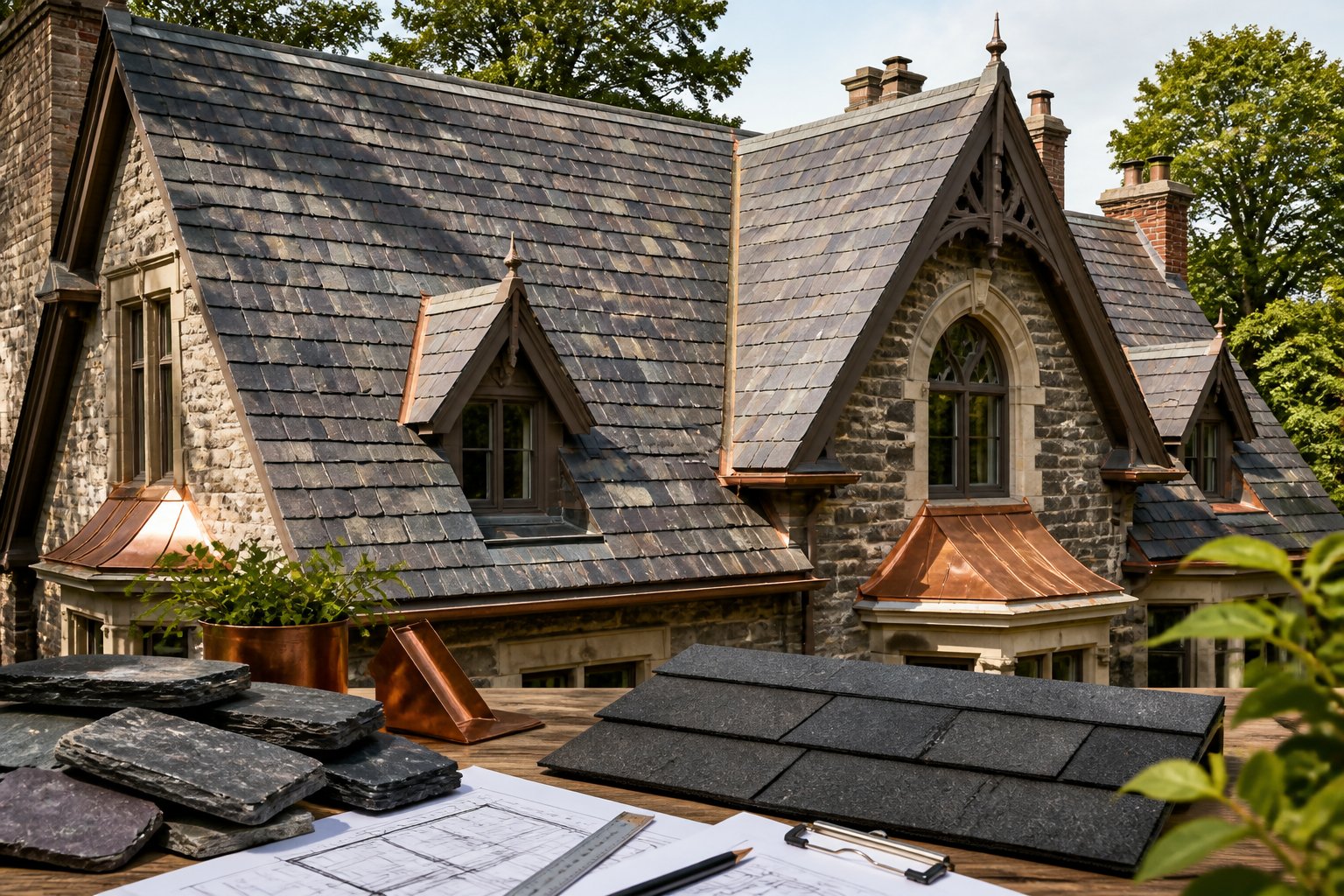
A punch list on an 1890s slate roof reads the same way on most heritage jobs: half the field is sound, a third of the slates are cracked, and the owner is asking whether to strip it all and shingle over the deck. That single question, reclaimed slate vs asphalt shingles, decides the next hundred years of that building.
The answer is rarely about which product is cheaper on invoice day. It is about what the structure already carries, what the neighborhood expects, and what the roof will cost to own across three or four decades of service. Contractors and architects who run that math tend to land in the same place on heritage work.
What follows breaks down how the two materials differ in fit, weather performance, lifecycle cost, structural demand, and resale value, including where asphalt genuinely belongs and where it does not. It is aimed at people who spec roofs, not people browsing.
Material Differences and Project Fit
One is quarried stone that was already on a roof for a century. The other is a fiberglass mat coated in asphalt and mineral granules, built to a warranty window.
Reclaimed Slate vs Asphalt Shingles: Decision Snapshot
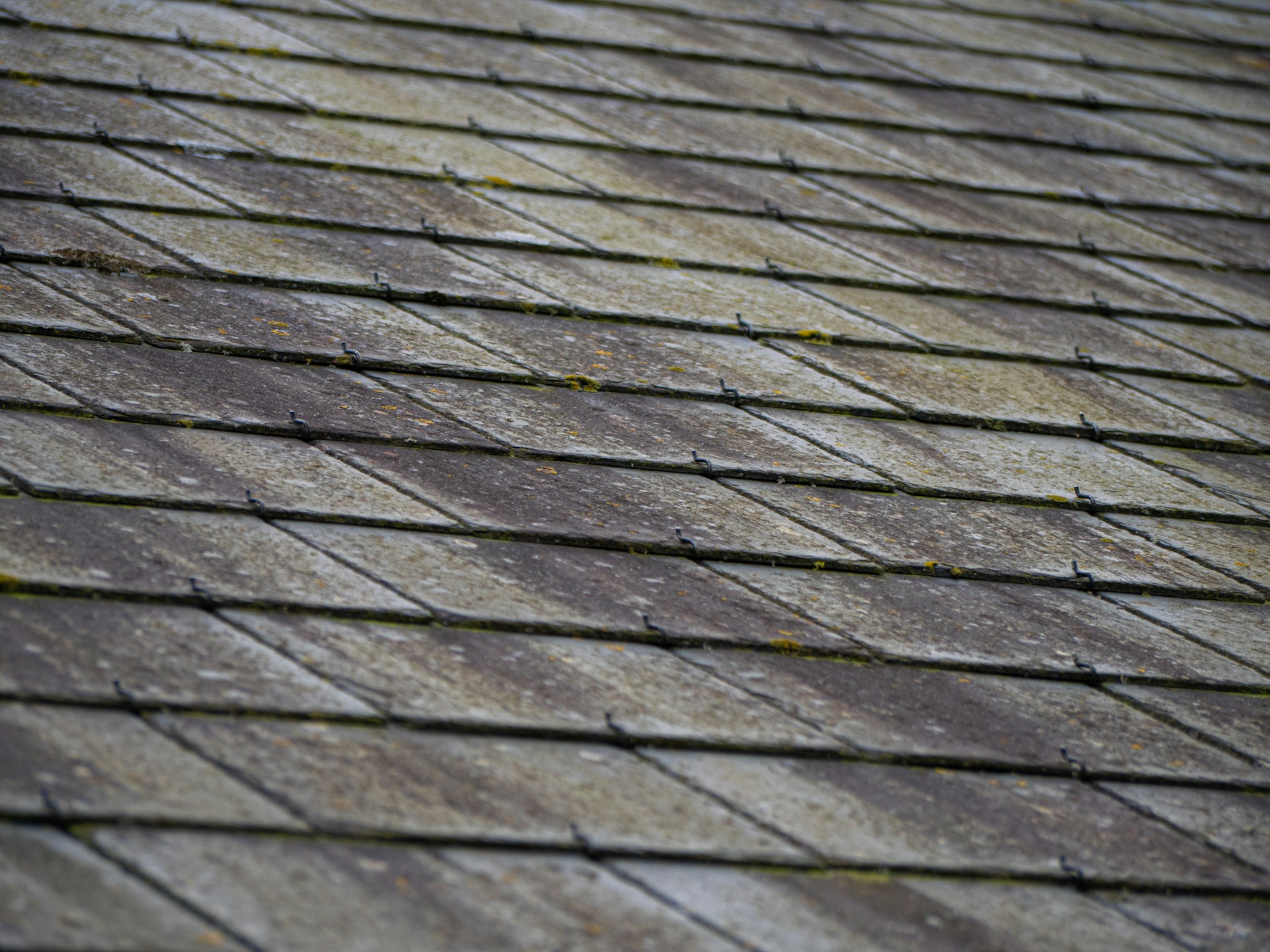
Natural slate is a metamorphic rock split into slate tiles. Reclaimed slate is that same stone, pulled off a historic building, sanded, and culled for reuse. Asphalt roof shingles are manufactured in runs and come as 3-tab shingles, architectural shingles, or dimensional shingles.
Here is how the two separate at the spec stage:
- Origin: salvaged historic stone versus factory-produced sheet goods
- Service life: 75 to 100-plus years versus roughly 20 to 30
- Weight: 700 to 1,200 pounds per square versus 200 to 350
- Repairability: individual slate replacement versus section tear-off
- Appearance: natural patina versus printed granule pattern
When Asphalt Shingles Fit Budget-Driven New Construction
Shingle roofs earn their place on tract housing, rentals, outbuildings, and any project where first cost drives the decision. The benefits of asphalt shingles are real: low material cost, fast install, and crews available in every market.
They are also light. A shingle roof rarely triggers a framing review, which keeps schedules short on speculative builds.
Why Authentic Slate Belongs on Heritage and Luxury Projects
On a landmark building, a shingle roof looks wrong from the street and reads worse in a preservation review. The National Park Service notes in Preservation Brief 29 on slate roofs that pattern, detailing, and craftsmanship are design elements worth repairing rather than replacing.
Synthetic slate tries to close that gap and misses on texture and depth. Reclaimed stone does not have to imitate anything. This matters once you start comparing how each material actually holds up outdoors.
Durability, Weather Exposure, and Service Life
Stone does not degrade the way a petroleum product does. That single fact drives most of the performance gap between these two roofs.
Expected Lifespan Under Proper Installation
A correctly executed slate roof installation commonly lasts 75 to 100 years, and hard slates go longer. Historic England notes that a stone slate roof's lifespan can reach at least a century when the roof is maintained.
Asphalt shingle installation delivers 20 to 30 years in most climates. Heat, ultraviolet exposure, and thermal cycling dry out the asphalt binder until granules shed and mats curl.
Fire, Wind, and Impact Performance
Slate is noncombustible, which is exactly why it dominated dense city blocks before manufactured roofing arrived. Fire resistance comes from the stone itself, not a coating or additive.
Wind resistance depends on nailing and headlap in both systems. Impact resistance is where they split: impact-resistant shingles are rated by class. Slate can chip under a heavy strike but will not tear or lift.
Freeze-Thaw Cycles, Moisture, and Repair Needs
Freeze-thaw cycles punish porous material. Low-absorption slate sheds water and resists that damage, which is why century-old roofs in the Northeast still hold their field.
Repairs also differ in scale. A cracked slate is a single-piece swap for a roofer with a ripper and a hook. That difference in serviceability feeds straight into the numbers.
Upfront Pricing and Slate Roof Lifecycle Cost
Slate costs more on day one. It usually costs less per year of service. That is the number worth building your comparison around.
What Drives Reclaimed Slate Roof Cost
Reclaimed slate roof cost moves with size, thickness, color, and how much of a matching batch exists. A common 18-inch by random field slate prices differently than a rare purple or a mottled green. Regional origin matters too, since Vermont, Pennsylvania, and Virginia stone weather differently.
Salvage yield also drives price. Stripping a roof carefully, then sounding and culling every piece, removes a meaningful share of the load. A detailed reclaimed slate price guide breaks down how those variables stack.
Asphalt Roofing Cost and Replacement Cycles
Asphalt shingles install cheaply and reinstall often. Over 80 years, you are budgeting three to four full roof replacement cycles, each with tear-off, disposal fees, underlayment, flashing, and labor at future rates.
Every cycle also puts the building at risk during the open-deck window. Owners rarely price that exposure until a storm finds it.
Comparing Total Cost of Ownership Over Decades
Run total cost of ownership per year, not per square. Factor these lines:
- Material and roof installation cost
- Number of replacements across the study period
- Tear-off and landfill disposal at each cycle
- Flashing, underlayment, and scaffolding renewals
- Maintenance and spot repairs
Slate front-loads the spend and then goes quiet for generations. Reaching that payoff, though, depends on what the building can carry.
Structural Readiness and Installation Requirements
Weight is the first gate on any slate project. Before pricing material, confirm the roof framing can accept 700 to 1,200 pounds per square foot.
Roof Framing, Load Review, and Structural Reinforcement
Most buildings originally roofed in slate already carry the load, since the rafters were sized for it. Buildings converted to shingles decades ago sometimes had framing altered during past work. Get a structural engineer to review rafter size, spacing, span, and deck condition.
Structural reinforcement, when needed, is usually sistered rafters or new decking. Not a rebuild.
Selecting a Qualified Roofing Contractor
Slate installation is a distinct trade skill. Plenty of capable roofing contractors have never hung a slate. This is not the roof to learn on.
Ask any candidate:
- How many slate roofs have you completed in the last five years?
- Do you use copper or stainless nails and copper flashing?
- What headlap and exposure will you specify for this pitch?
- Can you show a repair you made to an existing historic field?
Installation Details That Protect Long-Term Performance
Fasteners must outlive the stone. Copper nails, copper valleys, and correct headlap are what carry a roof past year seventy-five.
Nails should be set so the slate hangs, not so it is pinched tight. That detail alone separates roofs that last from roofs that crack. Once the technical case is settled, the visual case usually closes the decision.
Authenticity, Curb Appeal, and Long-Term Property Value
Stone reads differently from the sidewalk than any printed granule pattern. On a heritage street, that difference is immediate and permanent.
Historic Patina and Period-Accurate Material Matching
Reclaimed slate arrives with weathering already earned. That surface cannot be manufactured, only salvaged, which is why matching work depends on finding stone from the right region and era.
Color families like Buckingham Black, semi-weathering green, and grey each behave differently as they age. Practical matching starts with sizing and origin before color, not the other way around.
Natural Color Variation Versus Manufactured Uniformity
Natural slate tiles vary piece to piece in tone, thickness, and edge. Laid across a field, that variation gives depth that changes with light and weather. Architectural shingles and synthetic slate repeat on a fixed pattern. From the ground, the repetition shows, especially on long or steep planes.
How Roofing Choice Affects Curb Appeal and Home Value
Buyers of period homes price the roof directly. A sound slate roof removes a six-figure future liability from the transaction. This supports home value in a way a fresh shingle layer does not.
Curb appeal follows the same logic. A roof that belongs on the building makes everything below it look correct. That appeal holds up as material sourcing gets harder.
Sourcing Reclaimed Slate for the Next Roof Specification
Once slate is specified, the work shifts to finding real stone in the right size, color, and quantity. Supply is finite, and quality varies by yard.
Environmental Impact and the Value of Reuse
Reused slate carries no new quarrying and no new manufacturing energy. Every reused square avoids the extraction and firing energy a new roof would spend, and none of it shows up as fresh quarrying.
Asphalt shingles run the other direction. Every replacement cycle sends tons of petroleum-based material to a landfill. The environmental benefits of reclaimed roofing come from avoided waste, not offsets.
Batch Review, Hand Inspection, and Job-Site Delivery
Every credible batch should be sounded and culled before it ships. Ask for batch photos, thickness ranges, and the building or region the slate came from. Good reclaimed slate sourcing practice means you approve material before it moves.
Delivery matters on a schedule. Crated and palletized loads with liftgate service keep a crew working instead of unloading by hand.
Check Availability and Pricing Before You Spec
If you are specifying materials for a restoration or a matching job, call first. Reclaimed Slate Roofing carries rare formats and colors, including purple, mottled green, and semi-weathering green in 20-inch, 18-inch, and 16-inch random widths.
Call 225-954-8393 to check what is in stock and get real pricing. Most orders ship within 2 to 5 business days.
Frequently Asked Questions
How Does Reclaimed Slate Compare With Asphalt Shingles in Upfront Cost and Service Life?
Reclaimed slate costs more per square installed but commonly serves 75 to 100-plus years. Asphalt shingles cost far less upfront and typically last 20 to 30 years. Across an 80-year horizon, slate usually requires one roof while asphalt requires three or four.
What Installation Requirements Make a Reclaimed Slate Roof Different From an Asphalt Shingle Roof?
Slate needs copper or stainless nails, copper flashings, correct headlap, and a roofer trained in slate work. Nails are set so each slate hangs freely rather than being pinched. Asphalt shingle installation is faster and far less specialized.
Is the Existing Roof Structure Strong Enough to Carry Authentic Reclaimed Slate?
Buildings originally roofed in slate almost always are, since the framing was sized for the load. Buildings converted to shingles should get a structural engineer's review of rafter size, spacing, and deck condition. Reinforcement, if needed, is usually sistering rafters or replacing decking.
What Are the Main Disadvantages of Choosing Slate Instead of Asphalt Shingles?
Higher upfront cost, heavier dead load, and a smaller pool of qualified installers are the three real drawbacks. Reclaimed inventory is also finite. Rare colors and sizes are not always available on demand. Planning material sourcing early solves most of that.
How Do Maintenance, Repair, and Replacement Costs Compare Between Reclaimed Slate and Asphalt Shingles?
Slate repairs are usually single-piece swaps handled by a slater in a short visit. Asphalt damage often requires replacing whole sections and eventually the full roof. Slate maintenance focuses on flashings and fasteners. These are cheaper to renew than an entire field.
Will Insurance Coverage and Premiums Differ for a Reclaimed Slate Roof Versus Asphalt Shingles?
Carriers often view slate favorably because it is noncombustible and long-lived. Policies vary widely. Some insurers ask for documentation of material type, installation quality, and replacement cost. Confirm coverage terms with the carrier before the roof is specified.
Sourcing the Right Stone for the Job in Front of You
The comparison ends in a practical place. Asphalt shingles work for budget new construction. On a heritage roof, a landmark restoration, or a luxury build where the roof is a design element, authentic salvaged slate is the material that fits.
If you are matching an existing field or specifying a full replacement, start with what actually exists in salvage. Sizes, thicknesses, and colors drive the spec more than any catalog does.
Browse current inventory at reclaimedslateroofing.com, or call 225-954-8393 to talk through sizes, colors, and sourcing origins for your project. Real pricing, real stock. No waiting on a quote.